
Pashinyan: barriers to Armenian exports and transit persist in the Eurasian Economic Union
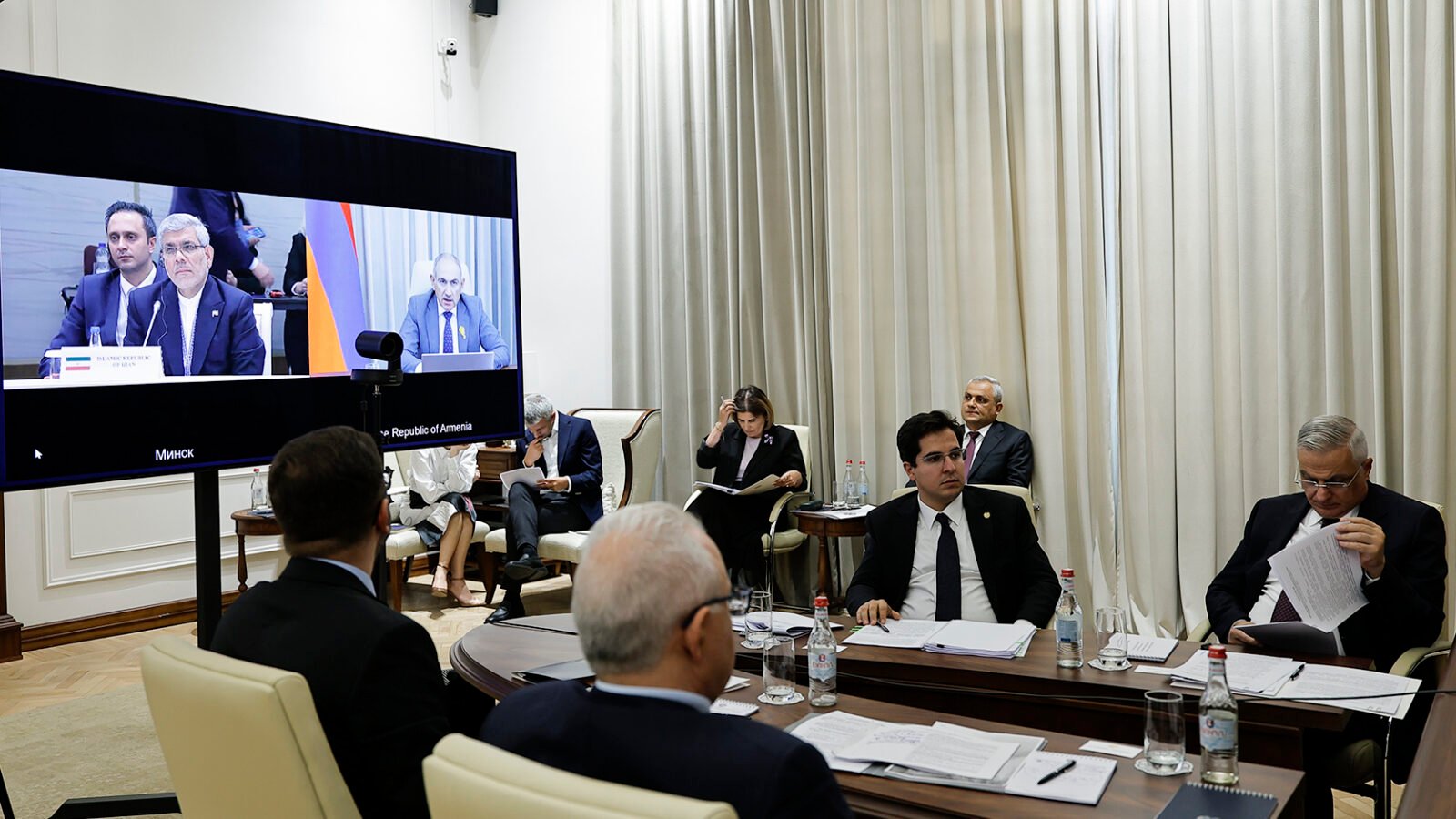
Restrictions and administrative barriers persist in the Eurasian Economic Union (EAEU) and continue to seriously hamper the full functioning of the single market, Armenian Prime Minister Nikol Pashinyan said at a meeting of the Eurasian Intergovernmental Council, which he joined remotely. He said that no significant progress had been made on a number of issues since the council’s previous meeting in Cholpon-Ata.
“In this regard, we consider it important to continue a constructive dialogue on removing the existing obstacles to the export and transit of Armenian products in line with EAEU law,” the prime minister said.
Pashinyan also stressed the importance of food security and predictable mutual supplies of agricultural products. He said joint forecasts for the agri-food sector and supply and demand balances make it possible to plan production and supplies and identify new opportunities for mutual trade.
The prime minister also spoke about TRIPP (Trump Route for International Peace and Prosperity), a key component of Armenia’s Crossroads of Peace initiative. The project will establish a direct rail link between Armenia and Azerbaijan, integrate Armenia into the international rail network and open the way for a rail connection between the Persian Gulf and the Black Sea. At the restricted-format session, Pashinyan briefed his counterparts on the unblocking of regional transport infrastructure and said Armenia expects solutions that will make its railways more efficient.
The Central Bank of Armenia forecasts that if the restrictions Russia imposed from June 2026 on imports of Armenian plant and animal products drag on, they could significantly hurt agriculture and, given the sector’s large share of employment, also weaken investor and consumer confidence.
The restrictions cover products whose exports amounted to about 1.2% of GDP in 2025. According to the Central Bank, the total value at risk is relatively limited, but most of the output of flowers, fish products and stone fruit goes to Russia, which makes it hard to redirect these volumes to the domestic market. Options for shifting to alternative markets in the short term are limited.
Armenia’s exports and imports, January-July 2026
| Direction | Exports, $ million | Change | Imports, $ million | Change |
|---|---|---|---|---|
| Total | 3,431.3 | -6.7% | 6,139.6 | +4.0% |
| CIS countries | 1,381.1 | -2.0% | 1,676.6 | -25.4% |
| of which EAEU | 1,324.5 | -4.2% | 1,491.0 | -27.9% |
| European Union | 516.5 | +80.2% | 1,293.3 | +28.4% |
| Other countries | 1,533.7 | -22.6% | 3,169.7 | +19.7% |
Change year on year. Source: Statistical Committee of Armenia.