
Armenia’s Agrarian University is developing a greenhouse robot
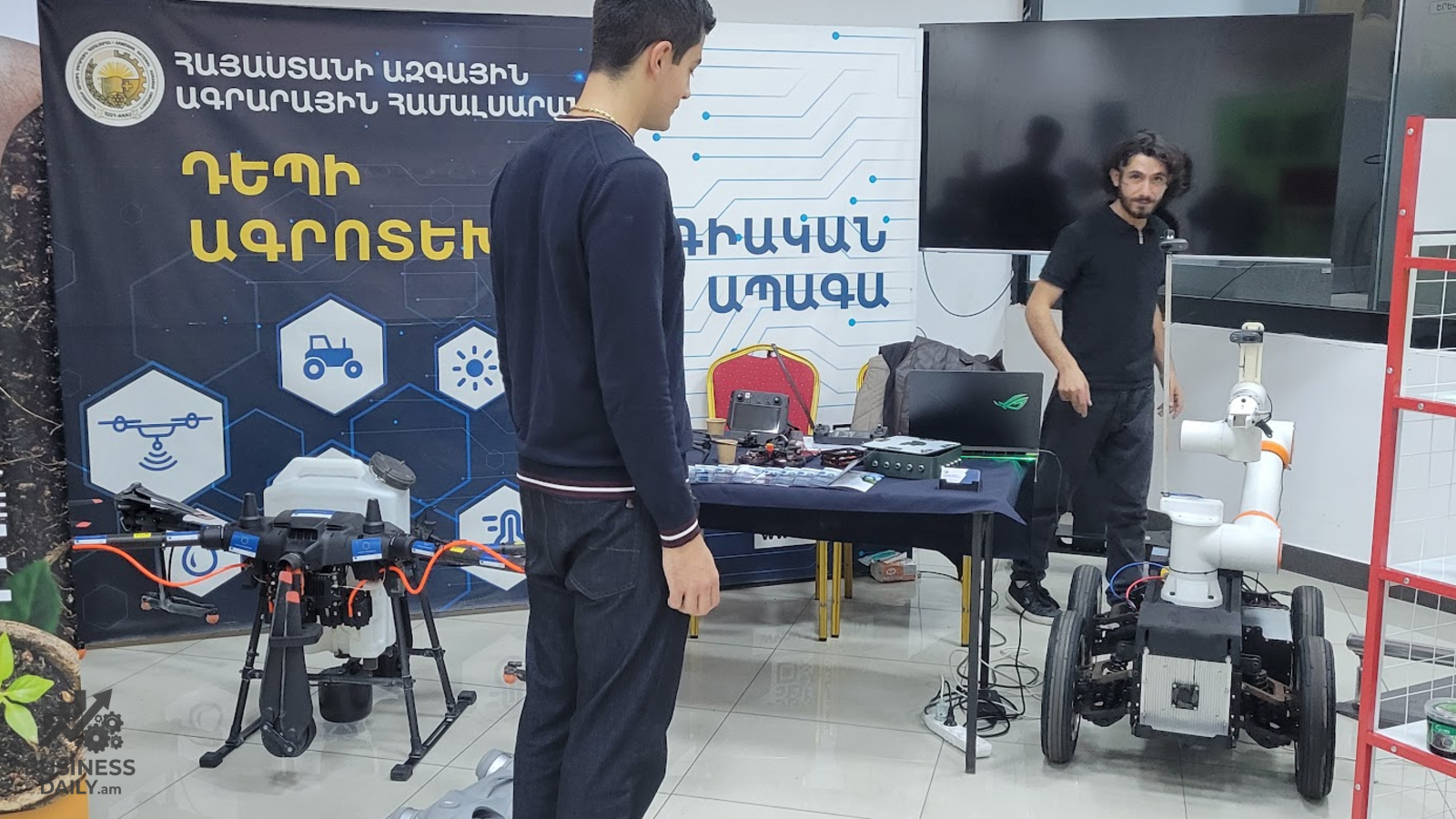
The Armenian National Agrarian University is developing a greenhouse harvesting robot whose competitive price could be about $20–25 thousand. The robot combines two platforms brought from China and is assembled and programmed in Armenia. Grish Ghurshudyan, a second-year student of the university’s Agromechatronics and Precision Robotics programme, said this in an interview with BusinessDaily.
According to him, the robot has built-in artificial intelligence: the developers aim for it to use cameras to determine whether a plant is ripe, monitor crops and detect plant diseases. “If a plant is not fit to grow before its vegetation stage, it removes it or reports that it should be removed and is not worth growing further. And after ripening it can harvest,” he noted. For now, however, the robot is operated manually. “At the moment it is under manual control. There you also add lidars, plus the price goes up further,” Ghurshudyan explained, referring to automatic control in a greenhouse. According to him, the chassis costs about $4 thousand and the arm about another $4 thousand. The robot is designed mainly for greenhouses and can rise up to 4.5 metres, the height of greenhouse tomato plants; the lifting mechanism has not yet been installed on the exhibition model. The robot is called Gardener, and according to Ghurshudyan, it is “entirely ours.”
Microchips and electronic parts that cannot be ordered in Armenia are sourced by the team from China. “The main part is microchips and electrical components, which are either very scarce in Armenia or not available at all,” Ghurshudyan stressed. In his words, the mechanics can be produced entirely in Armenia, and assembly can be done together with local companies. The team has already held talks with several factories: “There are even factories that have equipment for serial production, but their machines are idle at the moment, not working. They are also ready to do all this for us,” he added. In Ghurshudyan’s estimate, the robot could become a serially produced product in Armenia. He said the lab’s equipment allows the team to build several robots a month, while for larger-scale production it can order parts from different factories in Armenia and assemble them in one place. The team’s lecturers, who have scientific publications and patents, help with patenting.
Separately, the team works with a Chinese robot dog that costs about $2–3 thousand and serves as a training platform. According to Ghurshudyan, it can be modified, and the team is discussing technical issues and possible cooperation with the manufacturer. Based on it, the lab is building a new robot, a “shepherd dog” that is meant to keep sheep within a given area, track their health and behaviour, move them from place to place and record which ewes have been inseminated. The robot dog’s top speed is currently 10 km/h, and the team’s own model is being designed to be faster. “A shepherd dog cannot detect lambs’ diseases or assess their behaviour, while this robot monitors all of that throughout the day. At the end of the month it gives feedback that these lambs are healthy,” Ghurshudyan explained.
Together with one of the lecturers, the team is also developing a small drone for monitoring inside greenhouses. It photographs seedlings from above with multispectral cameras, and AI determines whether they are fit to be grown further. A field drone of the same model already exists: its camera has 6 sensors, each shooting in its own spectrum. “At the moment it is still a model. We are working on the cameras so that it is better and recognises better,” Ghurshudyan said.
The equipment-related work was financed by the World Bank: two years ago the university received €270 thousand, which was used to launch the Agromechatronics and Precision Robotics programme and acquire the equipment. The lab is called the Agrobot Centre of Excellence. The spraying drone shown at the exhibition was purchased with European Union support; students use it to learn flight control and run trials on the university’s land.


