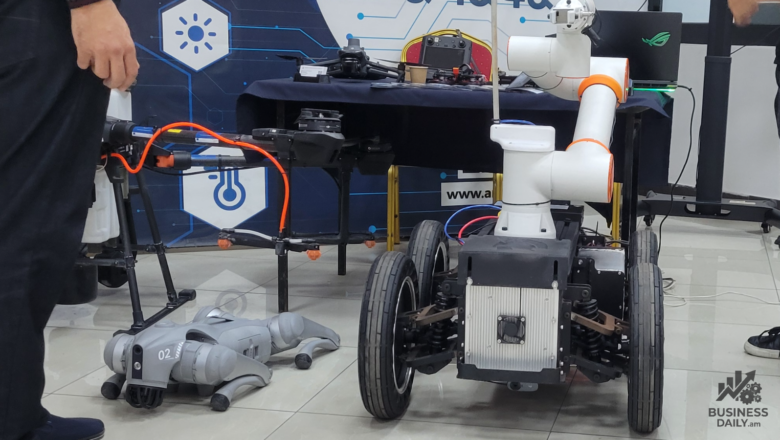
Armenia’s $14 million physical AI programme to receive first Agile Robots equipment this week

The first laboratory equipment for the seven-year physical artificial intelligence programme (the intersection of robotics and AI), worth AMD 4.83 billion ($14 million), will arrive in Armenia from German robotics company Agile Robots at the end of this week. Anik Margaryan, head of programmes at the ARCS.ai foundation, which coordinates the programme, announced this at a press conference at the Armenpress news agency.
The government approved the programme by decision, and it will run at Yerevan State University (YSU), the National Polytechnic University of Armenia and the American University of Armenia (AUA). Ani Virabyan, head of the Higher Education and Science Policy Department at the Higher Education and Science Committee, noted that the state will fund 50% of the $14 million. Margaryan pointed out that the programme had started before the government decision with support from private donors. Since ARCS.ai was founded in February 2025, at least 16 educational programmes and courses have been run in a year, and 5–6 visiting professors have come to Armenia, including from Brown University and the University of Michigan in the US and from Finland.
Margaryan named the US-based Armenia Fund, the Rev & Rachel Foundation charity and ServiceTitan co-founder Vahe Kuzoyan among the private backers. AUA both implements and co-finances the programme. On laboratory equipment, the programme works with Agile Robots, whose representatives will attend the DigiTec technology exhibition this week, and a separate event with international partners will be held on November 22. Anahit Sargsyan, executive director of the Armenian Innovation Foundation, added that the Physical AI Council set up by ARCS.ai includes NVIDIA Vice President Rev Lebaredian.
According to Virabyan, a permanent scientific core will be formed at the universities: up to 3 senior scientists, 12 or more postdoctoral researchers and 60 or more short-term visiting scientists, with a team of 15 researchers once the programme is fully running. Over seven years the programme is to produce 330 graduates, about 265 bachelor’s, 62 master’s and 6 doctoral students, with targets including 20 articles in international ranked journals, about 10 applications for major research grants, 2 patents and 5 start-ups and spin-offs.
The justification of the government decision states that no more than 100 students currently study robotics in Armenia. Hrant Khachatrian, head of the machine learning group at YSU’s Center for Mathematical and Applied Research and head of the YerevaNN lab, said about 20 scientists, mostly young, work in the YSU-linked groups. “Today it is impossible to assemble a 50-person team in robotics or artificial intelligence in Armenia. The aim of this programme is for this not to be the situation in a few years,” he stressed. Margaryan explained that in the coming years the programme should produce 50 graduates a year.
Khachatrian noted that leadership in physical AI cannot be built with $14 million “in a vacuum”, but other resources will also serve the programme. The YSU supercomputer, in which several million dollars were invested a few years ago, already devotes at least half of its resources to this field. The Ministry of High-Tech Industry has a five-year, $25 million contract with the Firebird AI centre for computing resources, and Khachatrian estimates that at least a third of it will go to scientific research. “If you add all of that together, it is not really just 14 million,” he added.
Sargsyan said at least half of the budget will come from the private sector, while the state contribution fixed by the government decision may change if the programme grows. The committee and the foundation will monitor it every year. Astghik Hakobyan, head of the Polytechnic University’s Laboratory of Intelligent Systems and Advanced Control and a lecturer at AUA, reported that the programme also plans to apply for large international grants. “And these $14 million will be given to us to create that capacity,” Hakobyan noted.
Khachatrian highlighted applications such as helping rescuers in emergencies and robotising industrial assembly lines, a process already under way in Japan, Germany and the US. “The aim of this programme is for Armenia to also enter these processes and have its say and its place in these topics,” he concluded.
Photo: Hayk Badalyan, Armenpress