Yervant Zorian: Armenia needs to develop a collaboration ecosystem for technology companies
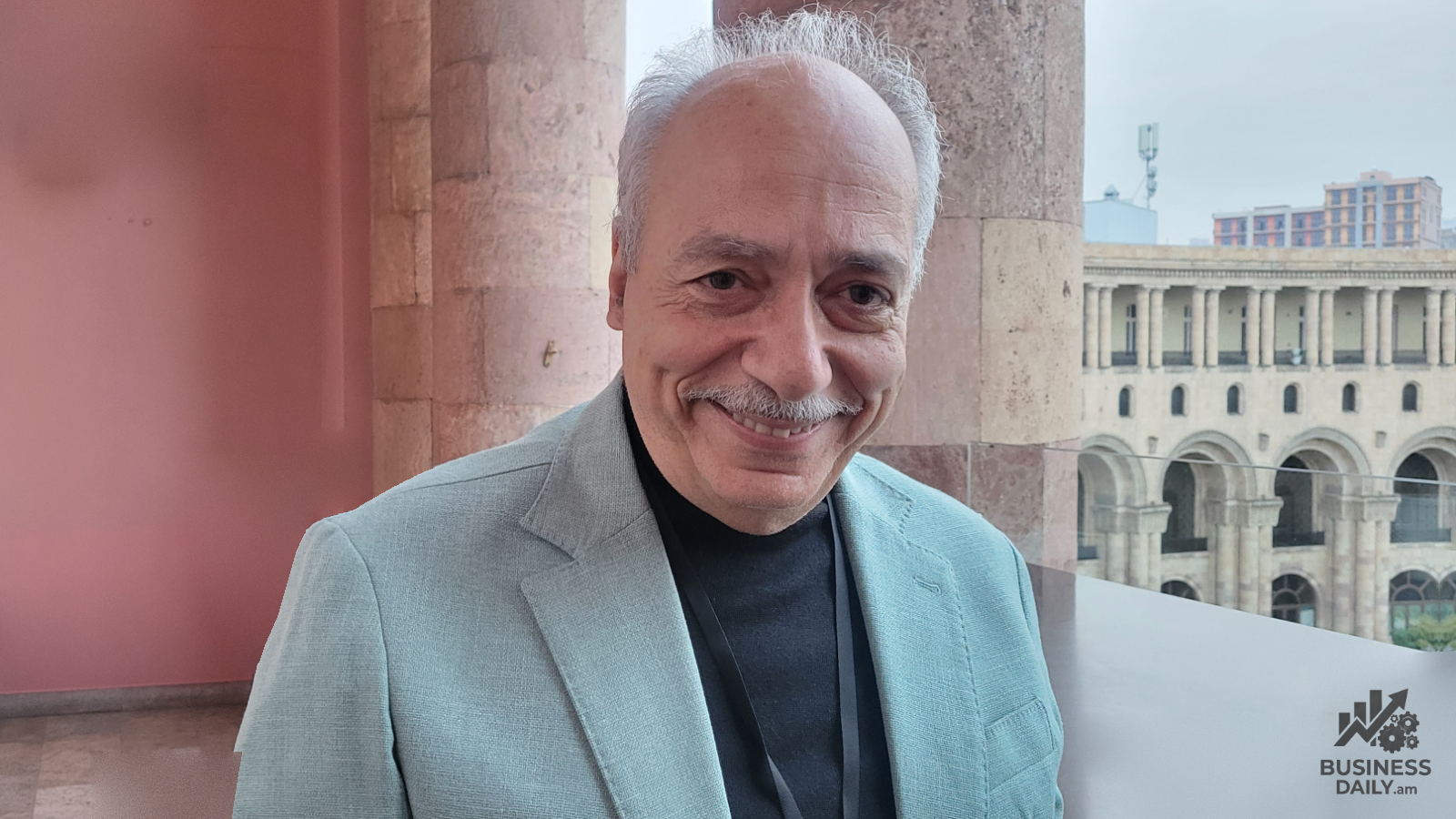
On the sidelines of the Silicon Mountains 2026 technology conference, we had the opportunity to talk with Dr. Yervant Zorian. Despite his busy schedule, he gladly found time for an interview and shared with Business Daily his views on the preconditions for innovation in Armenia, the country’s technological and scientific potential, and the importance of linking research with the international market. He also discussed the challenges facing the semiconductor industry and Armenia’s possible role in overcoming them.
Dr. Yervant Zorian is a recognised expert in semiconductor technologies and chip design. Electronic Engineering Times named him one of the 13 most influential figures in the semiconductor industry. Yervant Zorian is Chief Technology Officer and Fellow at Synopsys and President of Synopsys Armenia. During his career he has worked at AT&T Bell Laboratories, LogicVision and Virage Logic. He has authored four books and more than 400 peer-reviewed scientific papers, holds more than 45 US patents and has been a Fellow of the IEEE (Institute of Electrical and Electronics Engineers) since 1999. He is also involved in educational and pan-Armenian initiatives, including the Armenian Virtual College.
– One of the topics at Silicon Mountains 2026 was investment in innovation. In your view, what conditions are needed for long-term investment in scientific innovation in Armenia?
– Innovation has three components: talent, creativity and the right environment. If one of the three is missing, success is hard to achieve. In Armenia, a good deal of work is being done to train talented specialists and on workforce development. Some individuals also have creativity. But it is also important that companies and institutions have an environment where creativity is valued.
Not every technology company is creative and does research and development (R&D). Many mainly do development but no research. We can create much more value by combining development and research. Many just fulfil orders, doing development, and there is very little value in that. You can involve many or few people, but the added value can be small if there is no research component.
In Armenia there are companies like ours where the research component is strong and the development component is small. In others, research is small and development is large. Armenia has the capacity to do major research work, but these companies need to have the right culture and invest the right preparation in their products.
– Are there cases in Armenia where, for example, companies with a large research share and a small development share work with companies with a small research share and a large development share, complementing each other?
– Few. Unfortunately, in Armenia, in our field, the collaboration ecosystem is still weak. It needs to be developed. In some areas there is, of course, collaboration. For example, chip design requires software, intellectual property (IP) and manufacturing fabs. Creating a chip goes through many stages, and each of them requires specialised companies and collaboration.
However, we still do not have a complete, end-to-end ecosystem in Armenia. Some of its components exist, but the semiconductor industry has a global ecosystem that is not confined to one country. Today many countries are pursuing technological sovereignty, wanting to have as many stages of the technology chain as possible on their own territory. But building such a complete system is difficult for small countries.
– Can Armenia become a hub in some area of semiconductors without having full-scale manufacturing?
– Manufacturing is a very expensive pleasure. For chips it is like a printing house: you create the chip design, then prepare the masks and print the chip. On one side is the printing house, on the other the chip creator. To me, the creator is the author of the book and manufacturing is the printing house. So do we want to be the printing house or the author?
– The chain needs to be extended.
– Yes, the chain needs to be extended, but owning a printing house is a very expensive pleasure. With today’s technologies, building one production line costs about $30 billion, and for many that has been technically impossible.
I remember well that when I had just started working, about 40 different companies had their own “printing house” and made chips. And how many companies make the most advanced processor chips that way today? Only four in the world.
– Is Synopsys involved in creating the powerful NVIDIA Blackwell B200 and NVIDIA Blackwell B300 GPUs in the arsenal of the AI factories located in Armenia (Firebird and Eleveight AI)?
– Certainly. We were involved in the design of those chips. We took the chip design out, Taiwan does the manufacturing, the design is the US. They are NVIDIA chips, but NVIDIA’s chip designs are made with Synopsys tools. And today, if you listen to NVIDIA’s president, every year he comes to our conferences and talks about the partnership with Synopsys. We are not just a partner but an important strategic supplier. NVIDIA even invested in Synopsys to maintain our strategic relationship. With a $2 billion investment, it became the holder of 2.6% of Synopsys common stock.
– What needs to be done so that these AI factories work for Armenia?
– Our companies need to create tasks, because in the end you buy a computer, and if you have no tasks to run on it, the computer sits idle. Tasks are needed, computations are needed. Having a computer… it’s a chip, you need to do computations with the computer. So first of all our companies should be our researchers, they should do computations for research and for products, and universities and the academic community should carry out research and use it. Otherwise, if we don’t use it, foreign or US companies will come and do their work here.
– What are the main challenges in the global semiconductor industry?
– Well, semiconductor technology always advances according to Moore’s Law (the number of transistors on a chip doubles roughly every two years). We are keeping Moore’s Law relevant today, but not with monolithic chips, we can’t do it with those: we have to put several on top of each other, arrange them in layers (multi-die stacking). With stacked chips we can do it. We can continue our growth as before, but only if we stack chips on top of each other.
But already today we can have 1 trillion transistors in one chip. And if you look at the dimensions, we no longer measure in nanometres but in angstroms. The smallest technology today is 14 angstroms, which Taiwan can do. So with 14 angstroms we can have 1 trillion transistors in one chip.
– In chip design it is important to balance power, performance and area (PPA). In this respect, what is the biggest challenge to overcome?
– All of them matter together. But today the most important are power and heat, which are closely linked. When heat rises we have to lower power, because we want to use a small battery wherever it is: in a car, in a robot and elsewhere. So power and heat are the biggest challenge.
But fortunately there are ways to control them today. First of all, we need to be able to pre-simulate chips with artificial intelligence before releasing them, so you know how to protect them. For that you need a digital twin: you need the chip’s digital twin before manufacturing it. For this we use Ansys tools. Ansys is a specialised simulation software company, quite a large one. Synopsys acquired it recently, within a year, and Ansys has thermal, mechanical and stress simulations. Stress simulation is especially needed to test semiconductors in moving devices such as cars and robots, because motion creates mechanical stress, which can damage some transistors.
– What can you personally do for Armenia?
– I have a lot to do in Armenia, there is plenty of room to develop innovation in Armenia. But it should not be done so much for Armenia itself. Armenia is too small to develop innovation just for itself, whatever we do should be global. We should think about creating in Armenia but exporting to the global market. And since our technology still faces very many challenges.
And since the challenges in the semiconductor industry are very many, to reach this “trillion transistors”, for example, we have a lot to do both in our companies and in sister companies. For example, heat is one challenge, reliability is another, and the health of chips ensured by BIST (Built-In Self-Test) is yet another. (Yervant Zorian is the architect of the industrialisation of modern BIST and its chief standardiser. – Ed.) Ensuring these is necessary, because without it we cannot get there.