From Chips to Investment in the AI Era: Silicon Mountains 2026 Concludes Its Work
All graduates of the education programme run in Armenia by Synopsys, the US developer of chip design software, have found jobs in microelectronics, and 77% work at Synopsys Armenia. Professor Vazgen Melikyan, Director of the Education Department at Synopsys Armenia, presented the figures at Silicon Mountains 2026, Armenia’s ICT industry conference.
According to Melikyan, 56% of Synopsys Armenia’s employees went through the programme. It has produced 95 PhDs, 1,161 master’s graduates and 1,588 bachelor’s graduates.
The two-day conference, held under the motto “Invest in Innovation”, ended on November 4. Silicon Mountains, Armenia’s leading technology platform, has been organised since 2019 by the Union of ICT Employers (UEICT) with the support of Armenia’s Ministry of High-Tech Industry and Artificial Intelligence. The second day featured the International Microelectronics Forum, a Women Leaders Club discussion, a closing panel on investment and a meeting between technology students and Kam Ghaffarian. After talks by space, telecom and semiconductor leaders on the first day, the second focused on how next-generation chips are designed, the role of artificial intelligence in engineering, how women lead in tech and government, and how to invest in a fast-changing world.
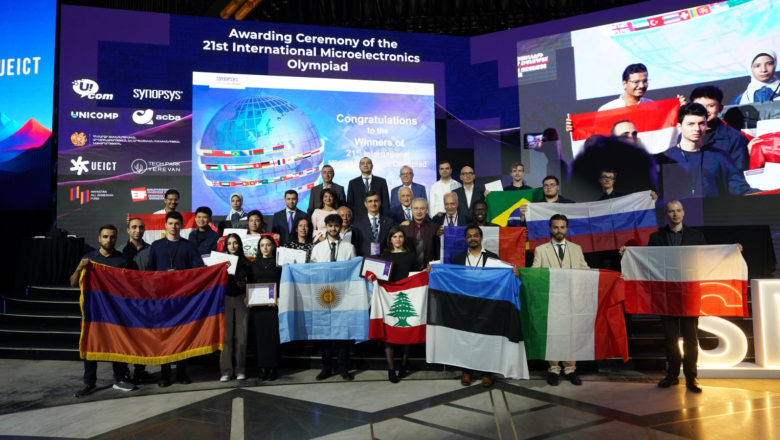
International Microelectronics Forum
The forum brought together speakers from leading international and local microelectronics and semiconductor companies. Their talks shared one theme: how next-generation systems are designed, tested and managed when complexity exceeds the limits of conventional approaches.
Dr Katayoun Basharkhah [CHECK spelling], Lead Technologist at Belgium’s IMEC research centre, presented the future of automotive computing platforms. In her view, the industry is moving towards heterogeneous chiplet-based systems driven by the demands of AI, performance and scalability. She stressed that this path requires standardisation and interoperability, and that the key question is no longer “can we build this?” but “how do we design and validate the right chiplet system before first silicon?”
Dr Artur Jutman, founder and CEO of Estonia’s Testonica, argued that classic testing is no longer enough given the complexity of high-performance and AI systems, and that test solutions should be reused across the entire silicon lifecycle, from manufacturing to in-field monitoring, while data gathered on the chip should be turned into fault management, from diagnosis to autonomous recovery. Faysal Shturu [CHECK spelling], Technical Account Manager at Siemens EDA, explained how artificial intelligence is changing design work. His three main points: agentic systems flag risks before they become problems, AI agents explore several directions at once, and expertise is captured in the tool rather than staying only with individual specialists.
Arsen Manukyan, head of Cisco Armenia, spoke about the evolution of AI networking, noting that it starts with silicon. He presented systems built on the Cisco Silicon One G300 platform with 100% liquid cooling and about 70% higher energy efficiency. Manuel Ohanyan of National Instruments stressed that in semiconductor validation AI mainly helps manage and improve existing workflows, speeding up test code scaling and anomaly detection, while human involvement remains the basis of product optimisation. Sergey Ghahramanyan, Lead QA Engineer at Cadence Design Systems, presented TimeVision AI Agent, part of InnoStack AI Super Agent, which helps detect SDC errors before final sign-off, and Harutyun Harutyunyan, General Manager of Xsight Labs Armenia, showcased the company’s open, programmable silicon for AI data centres, from switch to DPU, including a lightweight version of E1L.
Kam Ghaffarian meets students
Kam Ghaffarian, laureate of Armenia’s 2026 State Prize for Global Contribution to High Technology and co-founder of X-energy, Intuitive Machines, Axiom Space and Quantum Space, met students of Armenia’s technology universities. The conversation centred on what students should invest their time in. Presenting his IBX group of companies, he shared its motto, “Imagine, Believe and Execute”. His advice to students was simple: find your passion. “Find your passion, because when you find it, going to work every day is no longer work but a pleasure. Have the courage to do it. Think without limits,” Ghaffarian noted. He also spoke about persistence, determination and resilience as the qualities needed to reach a big goal. One of his favourite quotes is from Carl Sagan: “The sky calls to us. If we do not destroy ourselves, we will one day venture to the stars.”
Women Leaders Club discussion
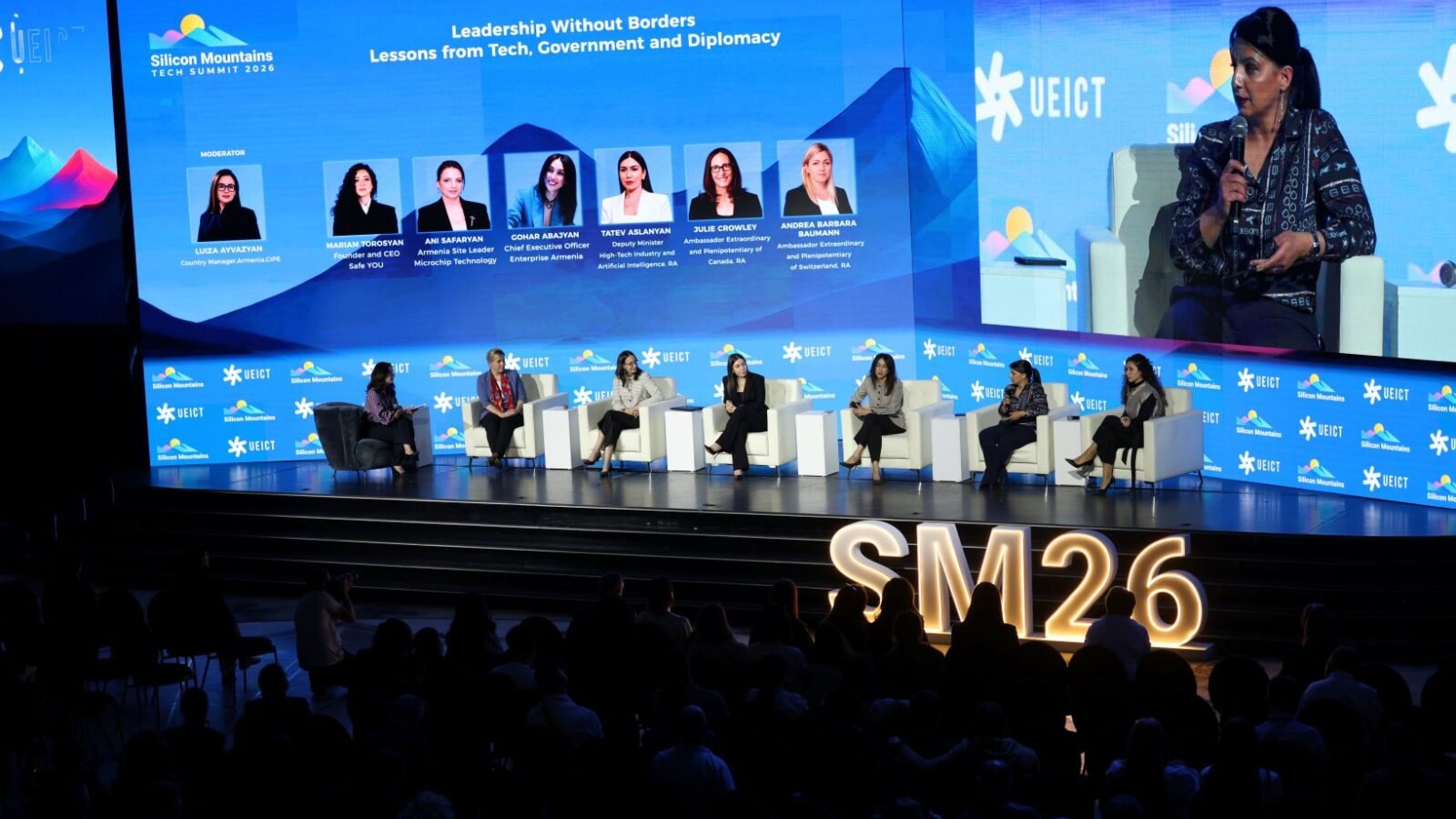
The discussion “Leadership Without Borders: Lessons from Tech, Government and Diplomacy” featured the ambassadors of Canada and Switzerland, Armenia’s Deputy Minister of High-Tech Industry and Artificial Intelligence Tatev Aslanyan, Enterprise Armenia Executive Director Gohar Abajyan, head of Microchip Technology’s Armenia office Ani Safaryan and Safe YOU founder Mariam Torosyan. It was moderated by Luiza Ayvazyan, Armenia country director of the Center for International Private Enterprise (CIPE).
Participants discussed the personal side of leadership: the boundary between personal and professional life, not compromising inner values for the sake of a career, and lack of self-confidence and how to work with it. Safaryan noted that consensus matters but should not become an obstacle, and that decisions must be made and owned: leadership is defined not by gender but by values, character and experience. Abajyan stressed the importance of candour, telling partners both what can be offered and what cannot.
Investment and the next conference
The conference closed with the panel “After AI: What Are Investors Actually Paying For?”, where participants discussed how to plan and invest wisely in a world where technologies, markets and projects change very quickly.
Over the two days, Silicon Mountains brought together representatives of the technology, investment and public sectors from Armenia and around the world. The event, featuring companies, startups, workshops and B2B meeting opportunities, was open to visitors on both days.
The organisers announced that the next regional Silicon Mountains will take place in Tavush province in northeastern Armenia, and the full-format conference will return in a year.
Source: Union of ICT Employers (UEICT), silicon-mountains.org