Zaruhi Muradyan: We can never produce $1 wine, our chance is quality and alternative markets
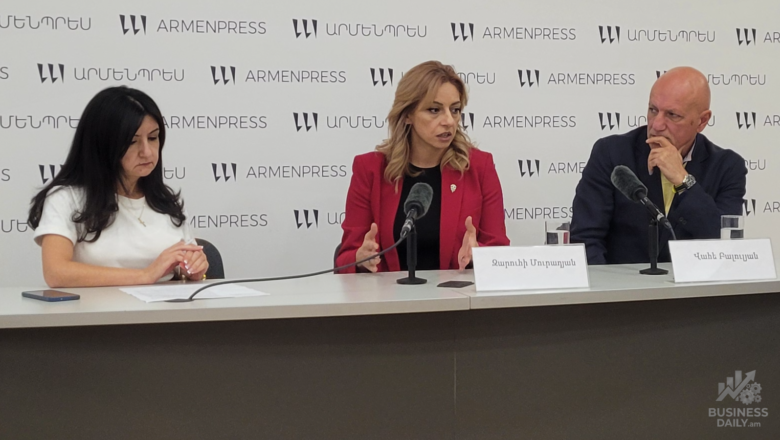
Business Daily spoke with Zaruhi Muradyan, Executive Director of the Vine and Wine Foundation of Armenia, about geographical indications, traceability of wine production and sales, relations between grape growers and winemakers, the European and Russian markets, staff training and the fight against counterfeiting.
— Let’s start with the geographical indication. The application for the geographical indication (GI) of Armenian cognac, “Armenian Brandy”, was submitted to the European Union back in March this year. When will there be an answer?
— What do you mean by an answer? The Minister of Economy has already signed the order, meaning the application has been accepted by ministerial order. Cognac producers can already use it if their products meet the established specifications. What remains are the final formal procedures.
— So it has been accepted? And in the European Union?
— From my experience, I can say that first of all, on the domestic market, inside the country, it can already be used freely. A cognac producer whose production meets the requirements of the specifications can already state this on the label and go to market. The European Union recognises the application we developed domestically: if we confirm that it is acceptable to us, it should be acceptable to them as well.
However, how the European procedure is going, how long it takes and where it stands, frankly, I don’t know, because we don’t deal with cognac; we are responsible for wine. I was involved in the process, took part in drafting the specifications and know them by heart. I also know that the order is already in place and all cognac producers agree with the stated requirements. Approval by the Intellectual Property Office of the Ministry of Economy is expected.
— My question concerns both wine and cognac. The European market grants preferences, but how do we bring our production in line with their standards, given full traceability, from the supermarket and the buyer to the farmer’s vineyard?
— I’ll answer your question in two parts. The Foundation is developing a vineyard register programme that will be fully ready in December. The aim is to be able to control full traceability: who the grower is, how many hectares of vineyard they have, what variety they grow, what harvest they get and whom they sell to. In turn, the producer fills in how much grape they bought from that grower and what they produced. This way we will control the entire chain.
The other aim relates to subsidies. Today it is very hard for us to forecast grape volumes, because we have no tools. We get data from community municipalities, which in turn ask growers how big this year’s harvest will be, and the growers give an approximate figure. Once we have the register, showing the number of vines and the variety, and we have yield data, we can say: my dear, you cannot get 40 tonnes from 1 hectare, because your vineyard is weak, your vines are incomplete, and you cannot show 40 tonnes on paper. The programme’s aim is to fight counterfeiting.
We see that when low-quality products are sold at some point and bans are then imposed to keep those counterfeit products off the market, the whole industry is paralysed. We say: here is our programme, we produce quality cognac and wine, and we will help you secure a firm place in that market too.
The European market, meanwhile, demands quality products. We go through numerous certification procedures and submit samples for analysis. That is why in the wine sector we have no problem entering the European market: over these years winemakers have learned what the requirements are and adapt their products so they can sell them easily.
Overall, exports have fallen in volume but grown in value, and we see the growth precisely in Europe. In other words, in Europe we sell more premium, higher-priced wines. In my subjective opinion, that is the only place we will succeed. That is why we are doing everything: the GI you mentioned, we have done for wine as well. We worked with winemakers and wrote specifications so that they, too, work with their growers and cultivate grapes in a way that produces high-quality wine.
Otherwise, we will not compete on low quality and price: we can never produce cheap $1 wine and cannot succeed with it. So we are doing long-term work with producers so that they, too, realise this and follow that path, and in the end we have uncounterfeited cognac and high-quality wine. Russia is certainly one of the most important markets for us, but we must find alternative markets so as not to be exposed to shocks.
— When will the time come when a farmer knows already today how much grape they will sell next year and at what price?
— I can share my opinion, though perhaps many will disagree. My experience shows that when there is healthy cooperation between the producer and the grower, even if the producer has no vineyards of their own but can work with their grower and they are loyal to each other, everything runs smoothly. There are growers who are very calm because they know their grapes will be sold at the desired price. And there are growers who have no contract with anyone all year.
Let’s take Areni, for example. This variety performs best and gives high quality when 7, 8, at most 10 tonnes of grapes are harvested per hectare. But there are growers who overload the vineyard so much that they get 20–25 tonnes. A winemaker will not come for those grapes, because they know they will get nothing good out of them and will not be able to sell it. If cooperation is healthy, I think supply and demand will balance out.
On the other hand, winemakers, realising they cannot work long-term with a grower, invest and plant their own vineyards. You will see that investors coming to Armenia in recent years first plant a vineyard rather than build a winery: in Vayots Dzor they plant hectares of Areni and only then build a winery. This problem will become more acute over time: if growers cannot work amicably with buyers, the problem will always be there.
I am also engaged in production and I can say that I tremble for my grower. I work with him, I am friends with him, and he is loyal to me: he will not sell my grapes to someone else for 10 drams more. He knows that I will take his grapes next year too, and that stable cooperation matters more to him than selling for 50 drams more and losing me.
— But is that realistic in our conditions?
— It has to take shape, and it takes years for people to grasp it. All his life the farmer has cultivated grapes one way and has not seen an alternative culture or the latest technologies.
— But shouldn’t he picture the whole chain, take someone as an example, and imagine how his grapes become wine and are enjoyed?
— That is our gap: winemakers must patiently carry out this work with their partners. I think the less the state interferes in these support programmes, the better. Healthy supply and demand must take shape. Once it does, the state will direct the money it now spends on helping growers to markets, sales and promotion, which, by the way, it is already doing: numerous programmes are under way. But healthy cooperation is the winemakers’ task: the winemaker must encourage the development of viticulture and work with growers. And the state will be glad to be rid of that headache and channel funds into bigger programmes and promotion.
— The French, for example, had small plots, poured wine into bottles, corked them, gave them a name and started producing boutique wines. Are there such examples in Armenia?
— That is exactly how we position ourselves, as a boutique wine-producing country, because, as I noted, in terms of volume we cannot even be compared with Georgia. But we have leaders, companies whose wines have won worldwide recognition and thereby opened the door for Armenia. I can’t name names, but they have spread their best practices, taught neighbouring producers and become quality setters.
When someone succeeds, people taste their wine and want to understand what the key to their success was, what they focused on, technology or vineyard cultivation, and they strive to reach that level themselves. A very interesting working style has developed here: winemakers understand that if they don’t unite, they won’t succeed abroad. There may be competition on the domestic market, but abroad everyone realises that if Armenian wine is not made recognisable and promoted, no one will succeed.
— The most essential thing is staff. Is there a winemaking faculty at the Armenian National Agrarian University, and are good specialists graduating?
— Yes, there is. Winemaking has been a very sought-after profession in recent years.
— So, while many professions in Armenia have already died out, the school of winemaking has survived?
— We also brought about a generational change: together with Germany’s best university, we set up the Wine Academy at the Agrarian University. The aim was to offer education with innovative solutions and to bring international experience to Armenia and put it into practice. At the same time, we helped the Agrarian University introduce these programmes, and the entire curriculum changed.
The course was specifically in English so that we could send our young specialists abroad for training and experience. They came back and applied their knowledge both at wineries and at the university, and today the best specialists teach at both the Wine Academy and the university.
We also introduced a dual programme, because winemaking is not just theory: a student has to feel and taste. We send students into production so that they work, study and gain experience at the same time. There have been cases when a student graduated in winemaking but had not yet realised what profession they had acquired. That is why, from the very first year, we hold classes in production so that they realise it.
— It’s interesting that you chose the Germans. Many people don’t even know Germany has winemaking, whereas Moselle wine is among the most difficult to make and among the tastiest.
— Yes, but their university is one of the oldest and strongest wine universities in Europe.
— How do we make sure the Areni story is not repeated, when the grapes have ripened, the harvest has taken place, and only then is the problem tackled with new subsidies?
— To be frank: when we have the register next year. It was a very complex programme and, unfortunately, it took a long time, but it will be a very powerful tool. Contracts will be visible on that platform: as early as May, contracts will have to be attached.
— So they will fully enter the tax field.
— That will be regulated by law. There we will see how many growers have no contracts, how many hectares or tonnes of grapes will be left “up in the air”, and how we will resolve the issue. In other words, everything will be planned, not at the last moment when we are already faced with a fait accompli.
Right now we get all information from community municipalities, which get it from growers and winemakers. The winemakers say roughly: we will buy this much, but for financial, export or sales reasons something may not work out, and they say: we cannot buy. We are faced with a fait accompli, and the state also tries to provide some support so that growers do not suffer. The subsidy programme is mainly aimed precisely at growers.
I think the register will help to grant subsidies in a more planned and correct way, make the whole process controllable and finally understand whether our supply and demand are balanced or whether we produce more grapes than we make wine from.
Look, Areni has become a calling card: all wine companies make wine from Areni. Tomorrow we will have a problem: are those wines really made from Areni? This tool, as well as the geographical name we will soon have, will ensure that only Vayots Dzor wine producers have the right to use that GI. That, too, will bring balance.
It takes a little time. I am being frank: the sector is developing fast, there are very, very many problems, and unlike other countries we do not have large international support to move forward quickly. We are moving in small steps.
— To what extent has winemaking become a family business?
— It is a very complex business that requires long-term investment. Today’s businesspeople are probably investing for their grandchildren (laughs). But it is a cause of national service, because, as I said in one of my previous interviews, wine is not merely an alcoholic drink: it is culture, community development and tourism; it can become the country’s brand and bring it recognition. That is why it requires more patience and serious investment, but it is a very sustainable and interesting business.
As for small, artisanal producers who actually make wine at home, we had an interesting programme in Vayots Dzor: we turned them into gastro-yards, they became guesthouses providing accommodation and food. Our goal is for the whole family to be involved in the business, so that people do not go abroad to work but earn money at home, on their own land. I think this spreads with a multiplier effect.
— There was a case where producers blocked a road and made demands, saying tomatoes had become so cheap that they could no longer pay their workers. Isn’t this rather a question of mindset?
— Yes, you are right, it is a question of mentality. Each of us must understand the country’s great potential and opportunities. When people realise that on their own land, with their own water, in their own conditions they can create more value, material, human and national, they will live inspired by it. We need to work with people, inspire trust, spread best practices and show: look what your neighbour, a farmer just like you, is creating, because he believed in his potential.
— Last question. About imports of distillates and spirit from other countries. Is wine fortified with spirit?
— Let’s not mix up wine: I don’t think that kind of counterfeiting exists in wine; it concerns cognac more. Frankly, I don’t know of a single winery that could counterfeit wine.
— But sometimes you buy wine at a supermarket and…
— Perhaps it was not made well, but counterfeit, hardly. Again, this is my subjective opinion, but believe me, I work with the sector, I visit wineries every day, and I cannot say that any winery could counterfeit. The technology may not be good and the wine may not turn out well, but counterfeiting, I don’t think so.
As for spirit, it is imported for various purposes: it is imported and re-exported. The law allowed spirits to be used in blends, it was not prohibited, and it may have been used precisely for blends. But in the case of wine… I cannot assure you of the opposite.
— The whole point of a GI is that this chain is not broken.
— Yes, of course, and the key here is the register. The GI will be linked to the register, and the entire production process will be monitored, starting from the grapes. One can talk about the need for control, but you need tools for that. If you have no database, you cannot control anything: what are you going to control if you don’t know how much there was?
We have mapped all of Armenia’s vineyards and filmed them with drones, so close up that every vine is visible. I think we should use this so that control is carried out properly rather than as a formality, which will in turn lead to quality.
— Does the state have sufficient capacity to organise certification to European standards?
— Yes. We have never had problems with wine, and the opposite is being proven. Europe is the most difficult wine market: they are more fastidious there, they are wine-producing countries themselves and choose more demandingly. If we sell wine in Europe and sales are growing, it means we are really talking about quality wine producers who make wine specifically for that market.
— I wish you patience. The sooner winemakers and grape growers understand that this is a living organism, from the soil to the bottle, the better.
— Thank you very much. In fact, this is a very big effort involving the private sector, the state and growers, and, I am being frank, it works in a very interesting way. Through the Foundation we raise the problem with our ministry, the ministry responds very quickly, and we try to offer solutions so that the sector is not exposed to shocks. If all of us, winemakers, the foundation and growers, do our work properly, the sector will not be exposed to shocks, and our finances will go to other programmes, which will make us even stronger.
Background
Under the Armenia–EU Comprehensive and Enhanced Partnership Agreement (CEPA), the name “cognac” will be banned on Armenia’s domestic market from 2032 and dropped for exports from 2043; the 13- and 24-year periods are counted from one year after the start of the agreement’s provisional application (1 June 2018) (agreement text on the website of Armenia’s Foreign Ministry, Articles 237 and 385, file pages 213–215 and 354). In return, the EU committed to provide, no later than eight years on, that is by June 2026, technical and financial assistance for creating and promoting a new name; if no assistance is provided, Armenia has the right to suspend its obligations related to the name (ibid., Article 237, paragraphs 4–7). The EU programme “Technical assistance for the development of the ‘Armenian Brandy’ geographical indication”, worth 2.85 million euros, ran from 20 June 2024 to 19 June 2026 (EU project sheet); the European Commission describes it as the “difficult phasing-out of the Cognac and Champagne names” (EU Directorate-General for Agriculture). The Ministry of Economy filed the application for the “Armenian Brandy” geographical indication on 13 March 2026: brandy distilled from wine material made only from Armenian grape varieties (Intellectual Property Office Bulletin No. 03/2 of 16 March 2026, pages 471–472). The EU programme has ended, and there is still no decision on registration. In the EU, products with a geographical indication are on average 2.5 times more expensive for spirits and 2.85 times for wines (EU study).
Ethyl alcohol: Armenia imports practically none (2025: $150 thousand), but it imports spirits and distillates (HS 2208) worth $68.9 million, of which $31.4 million came from Georgia (customs data).
Wine and cognac exports in 2025: compared with 2024, the physical volume of wine exports rose 0.3%, while cognac exports fell 19.9% (Statistical Committee of Armenia).
Cognac’s dependence on Russia: 83% of cognac exports go to Russia. The figure is given in the analysis of the four-country report on the possible consequences of suspending EAEU membership (Government of Russia, sections 4.2–4.3 of the report).
Wine production in 2025: about 8 million litres, down 18.5% (1.8 million litres) from 2024 (Ministry of Economy of Armenia, rationale for a draft, October 2026).
Wine production in January–July 2026: 4,189.0 thousand litres, up 26.4% year on year. Sparkling wine production totalled 652.7 thousand litres (+21.6%) (Statistical Committee of Armenia).
Total exports in January–September 2026: $5,163.1 million, 8% less than in the same period of 2025 (Statistical Committee of Armenia).
The 2026 Areni procurement problem: the expected Areni harvest in Vayots Dzor is about 5,400 tonnes, of which 3,400 tonnes are covered by contracts or domestic consumption, while about 2,000 tonnes are left without a buyer. The market price of Areni is about 230 drams/kg, compared with 135–140 drams/kg for grapes bought for cognac spirit. The Ministry of Economy of Armenia proposes allocating about 140 million drams from the government’s reserve fund as a subsidy of 70 drams/kg, on condition that the buyer purchases at least 800 tonnes of Areni at no less than 210 drams/kg.
Procurement loan deadline: under Government Decision No. 201-L of 28 February 2019, the size of the subsidised grape procurement loan is calculated on contracts concluded before 1 August. For 2026, it is proposed to extend the deadline to 15 November, which would require about 270 million drams in additional loan funds (Ministry of Economy of Armenia).
Register and contracts: the vineyard register will be launched in December 2026, and from next year procurement contracts will have to be attached on the platform by May (Vine and Wine Foundation of Armenia).
Sources:
Statistical Committee of Armenia — https://armstat.am
Ministry of Economy of Armenia — https://mineconomy.am
Armenia’s portal for publishing draft legal acts — https://www.e-draft.am
Government of Russia, four-country report on the consequences of suspending EAEU membership — http://government.ru/news/60241/
Photo: wineanorak.com