Foldink and TI-3D develop a fully Armenian compact bioprinter
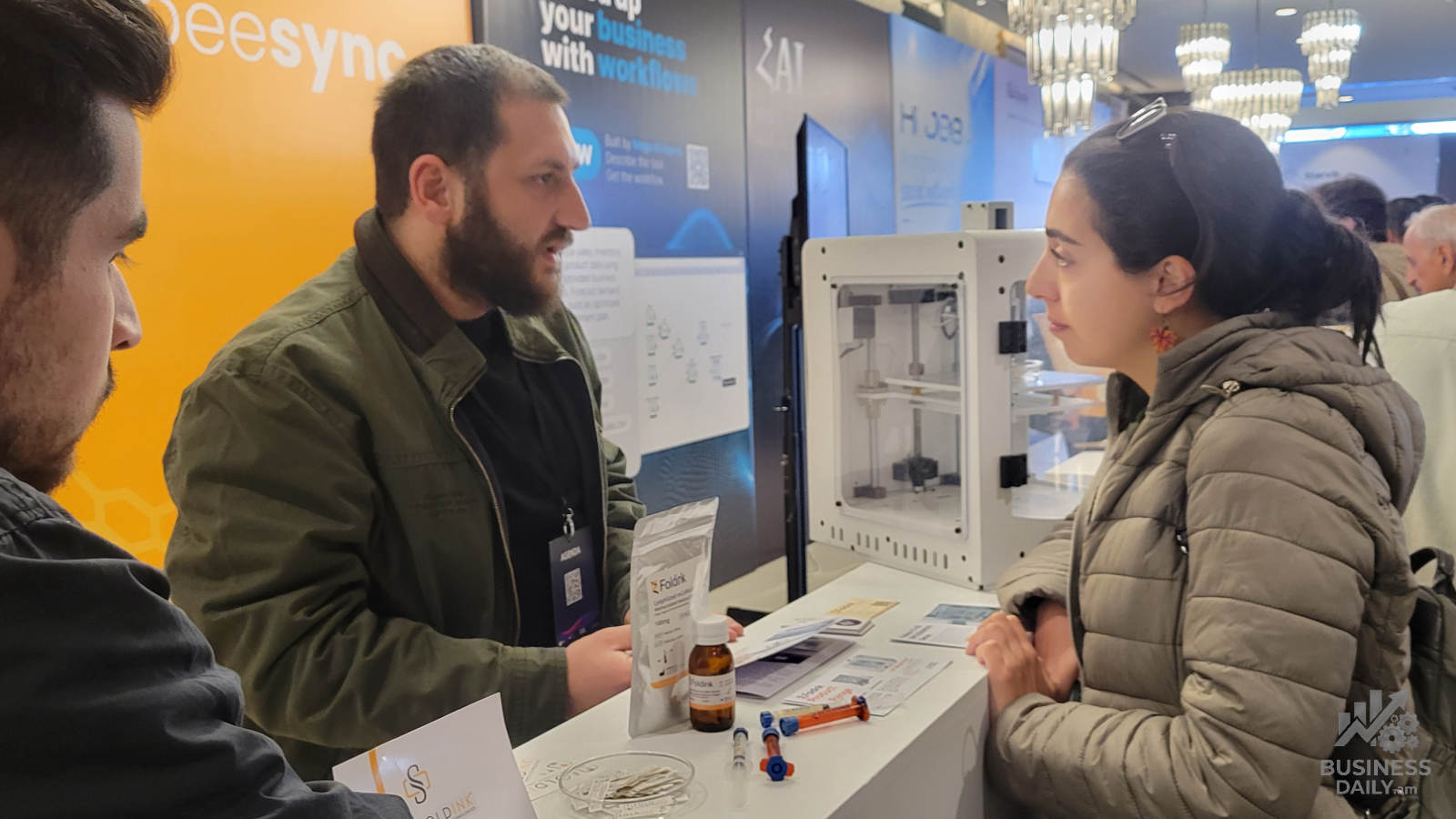
Armenian bioengineering company Foldink is developing the Foldink TI3D Ontogenesis bioprinter together with Armenian company TI-3D, a compact device that will be able to work with four or more biological materials at once. Foldink CEO and co-founder Vahan Grigoryan said this in an interview with BusinessDaily.
What Foldink makes
Foldink makes 3D bioprinters and the biological materials they use, known as bioinks. Biomedical scientists mix these materials with living cells, load them into a bioprinter and obtain structures that mimic tissue.
On its official website, the company states that it offers ready-made hydrogel and lyophilized (freeze-dried) bioinks, customization of their composition to a laboratory’s requirements, and modular bioprinters. Listed applications include regenerative medicine, drug discovery, cosmetics testing, personalized medicine and cultivated food.
The company’s base bioprinter is the Foldink Extruder 5. According to Grigoryan, it is a simple but effective technology and a good option for laboratories that are just starting out. The device was developed with China’s Wanhao in a standard configuration and has a single extruder, with print accuracy of about one millimetre or finer, typical of the extrusion method.
Ontogenesis: a fully Armenian design
Unlike the Extruder 5, Ontogenesis is being developed entirely on an Armenian base. The new device will have four or more extruders, and thanks to its modular design their number can be raised to five, six or more without changing the size of the device.
Grigoryan noted that six-extruder bioprinters available worldwide are roughly the size of a table, while Ontogenesis will be considerably smaller, which matters for optimizing laboratory work. The device will include an innovative component whose details the company has not yet disclosed. It will allow printing with many materials, and in large quantities, under conditions of enhanced sterility. In Grigoryan’s view, this will give it an advantage over both simple bioprinters and the world’s leading ones.
Markets and pricing
All of Foldink’s customers are abroad. As Grigoryan explained, there is no other bioprinting company in Armenia or the region.
Most sales are in Western Europe and North America (the US and Canada), and sales to Russia and Eastern Europe have recently begun.
Talks are under way with interested parties from China, Japan and other countries of the Far East.
The company has been presented in various countries, from Germany to Taiwan.
The devices are not mass-produced. Foldink works order by order and plans to continue doing so in the near term, because the market is narrow and each research laboratory has its own specialization and needs a specific configuration. The price is set for each order depending on the configuration and delivery destination. To get a quote, an official request must be sent through the company’s website, foldink.bio.
The company and its work with universities
According to Foldink’s website, the company was founded in 2018 and registered as Foldink Corp. in 2021. Its co-founders are physicians Vahan Grigoryan (CEO), Emanuel Ghandilyan (lead co-founder) and Hamlet Khachatryan, as well as Gevorg Sargsyan, co-founder and CEO of KidZania USA, who also serves as strategic advisor.
Grigoryan added that the company works closely with Saribekyan International Medical University, where he has been appointed head of the university’s research division. He stressed that it is the only university in Armenia that teaches students advanced bioengineering and bioprinting technologies.
Editor’s comment
What is it? Armenia’s only bioprinting company is developing its first fully Armenian device, intended to compete with global leaders on compactness and the number of materials used at once.
Who needs it? Biomedical and tissue engineering laboratories, pharmaceutical and cosmetics companies that run tests on tissue models, and universities that teach bioengineering.
What it means. Foldink is an example of high-tech exports with demand almost entirely abroad. The absence of a domestic market shows that bioprinting has not yet become part of Armenia’s scientific and educational infrastructure.
What to do. Laboratories can request a quote or a free demonstration through foldink.bio. For universities and research organizations, this is a reason to consider adding bioprinting to research and teaching programmes. Investors should follow the development of Ontogenesis, as the company has not yet announced when it will reach the market.