
Armenia’s Creative Economy Receives Official Statistical Measurement for the First Time: Share in GDP Reaches 6.7%
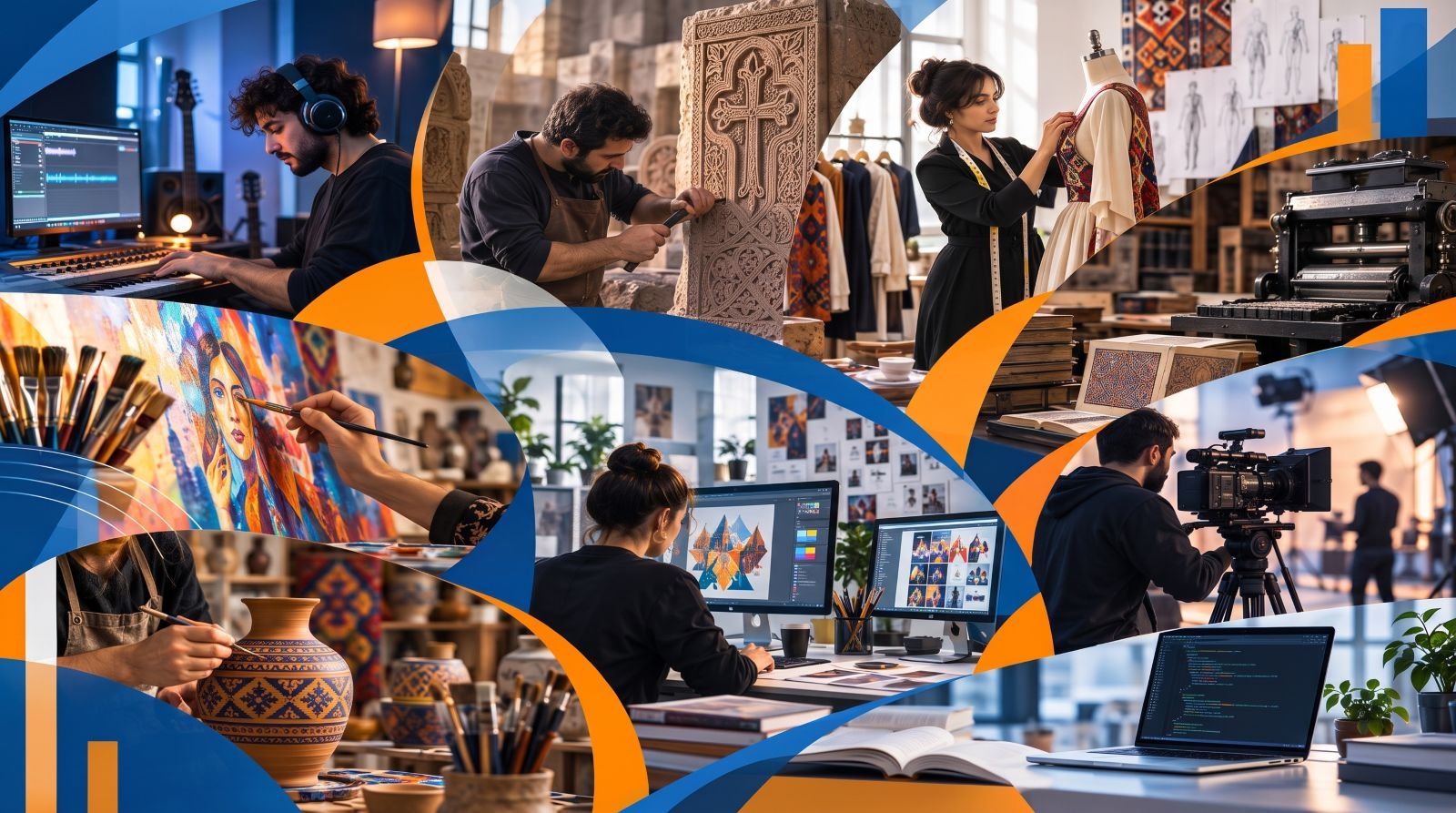
The Statistical Committee of Armenia (Armstat) has published for the first time the comprehensive statistical bulletin “Creative Economy in Armenia, 2021-2024”, based on the new international methodology of UNCTAD (United Nations Conference on Trade and Development). The study shows that the creative sector is becoming one of the most dynamically developing segments of the Armenian economy, demonstrating steady growth in key indicators including the number of companies, employment, wages, value added and exports.
Creative Economy Strengthens Its Position in the National Economy
According to the study, the gross value added generated by the creative economy increased from AMD 330.7 billion in 2021 to AMD 687.0 billion in 2024, more than doubling over four years. As a result, the sector’s share in the country’s gross domestic product increased from 4.7% to 6.7%, while its share in the economy’s total gross value added reached 7.4%.
Number of Companies Almost Doubled
Between 2021 and 2024, the number of economic entities operating in the creative economy increased from 10,135 to 20,210 organizations, virtually doubling.
The software, video games, computer and web services segment remains the leader by number of companies. In 2024, 10,020 companies operated in this segment, accounting for almost half of all entities in the country’s creative economy. Manufacturing of crafts and design goods ranked second with 4,052 organizations, while music, performing and visual arts completed the top three with 1,403 entities.
Number of Employees Exceeded 100 Thousand People
The creative economy is becoming a significant employer. The total number of employees in the sector increased from 82.2 thousand people in 2021 to 101.6 thousand people in 2024, growing by almost 24%.
The largest employers are:
- software, video games, computer and web services — 32,186 employees;
- music, performing and visual arts — 20,661 employees;
- manufacturing of crafts and design goods — 20,508 employees;
- research and development — 6,204 employees.
Thus, every third employee of Armenia’s creative economy works in the digital segment, confirming the growing role of the IT industry as the core of the country’s modern creative sector.
Wages
The average monthly nominal wage in the creative economy increased from AMD 288.5 thousand in 2021 to AMD 467 thousand in 2024, representing growth of more than 61%.
The highest wages were recorded in the software, video games, computer and web services segment, where the average salary reached AMD 1.055 million per month in 2024. It was followed by:
- advertising and marketing — AMD 339.6 thousand;
- audiovisual arts, multimedia and photography — AMD 314.4 thousand;
- research and development — AMD 268.3 thousand;
- architecture — AMD 248.7 thousand.
IT Generates More Than 60% of the Sector’s Value Added
The digital segment plays a key role in the structure of gross value added generated by the creative economy.
In 2024, software, video games, computer and web services accounted for 61.8% of the entire gross value added of the creative economy, compared to 44.7% in 2021.
Manufacturing of crafts and design goods ranked second with a 13.1% share, followed by music, performing and visual arts with 6.5%. Advertising and marketing accounted for 5.0%, while architecture contributed 3.7%.
This indicates a gradual transformation of the creative economy toward sectors with high value added and export potential.
Exports of Creative Goods Increased Nearly Ninefold
One of the most impressive results of the study was the growth of exports of creative economy goods in Armenia.
While export volume amounted to AMD 43.2 billion in 2021, it reached AMD 385.6 billion in 2024, increasing nearly ninefold.
The share of creative goods in the country’s total merchandise exports increased from 2.9% in 2021 to 7.5% in 2024.
The main share of export supplies is generated by the manufacturing of crafts and design goods. In 2024, this group accounted for 99.4% of total creative economy exports.
A New Stage of Statistical Measurement
Armstat notes that the publication of the bulletin became the first attempt to systematically measure the creative economy in Armenia based on the new methodology of the United Nations Conference on Trade and Development (UNCTAD 2024). The new approach will improve international comparability of data and provide a more accurate assessment of the contribution of creative industries to the country’s economic development.
According to Armstat experts, the results of the study confirm the formation of a sustainable creative cluster in Armenia, where digital technologies, software, cultural industries, design and intellectual labor are becoming important sources of economic growth, employment and export revenues.