Pashinyan says EAEU members have no right to expel Armenia from the union
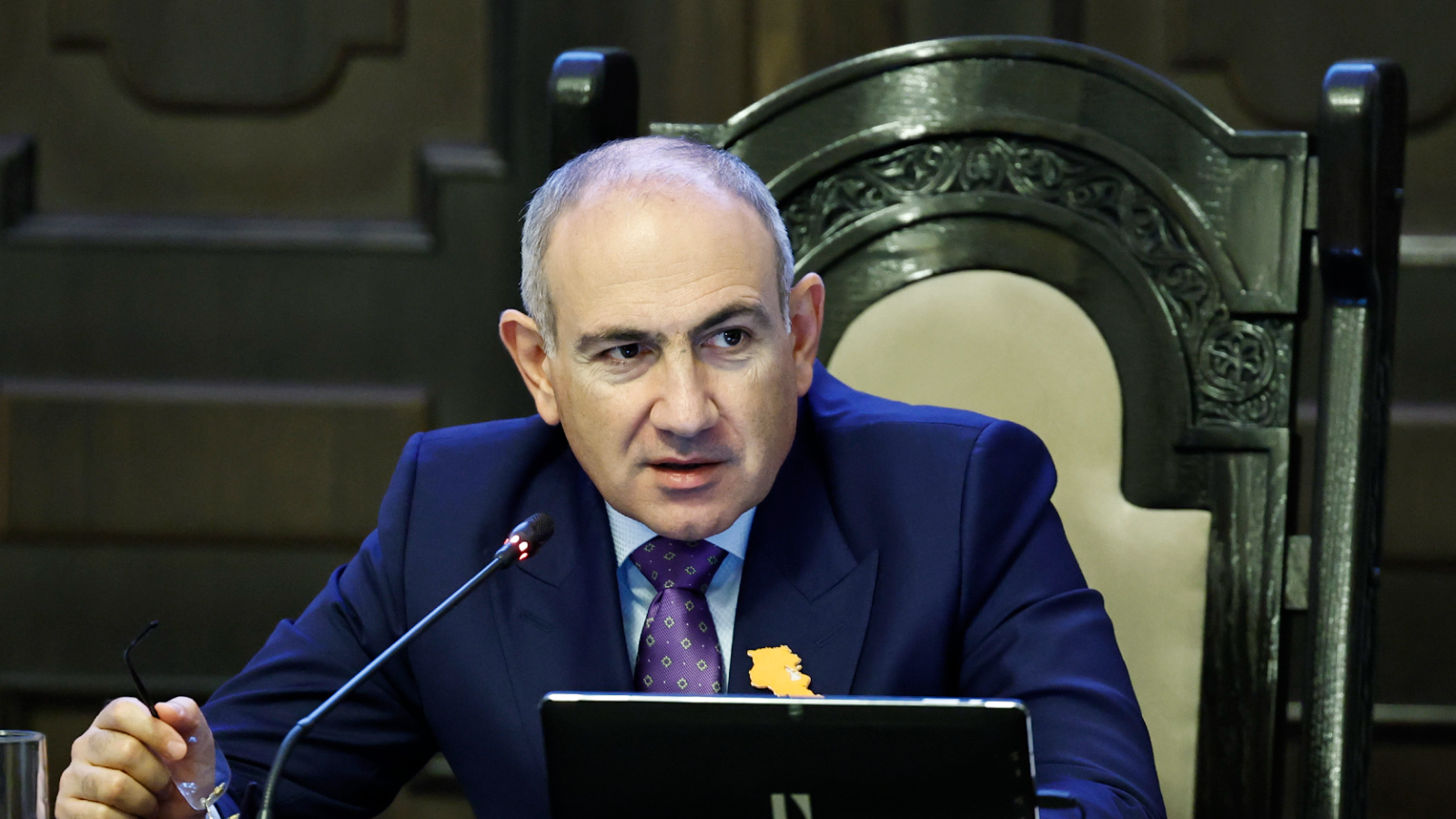
Armenian Prime Minister Nikol Pashinyan responded at a briefing after the cabinet meeting to a report prepared by four member states of the Eurasian Economic Union (EAEU): Belarus, Kazakhstan, Kyrgyzstan and Russia. The report assesses the possible consequences of suspending Armenia’s EAEU membership. According to the prime minister, the document itself shows that member states have no right to expel Armenia from the organization.
What the four countries’ report says
The report was published on the Russian government’s website. It was prepared on the basis of a joint statement by the presidents of Belarus, Kazakhstan, Kyrgyzstan and Russia of May 29, 2026. That statement was a response to Armenia’s steps toward joining the European Union (EU).
According to the report, the four countries may discuss a temporary suspension of Armenia’s membership. The suspension could last until a referendum in which Armenia would choose between the EU and the EAEU. At the same time, the document’s authors acknowledge that the EAEU treaty provides no mechanism for expelling a member state. The issue is expected to be discussed at the EAEU summit in December.
The document estimates that if membership is suspended:
- Armenia’s gross domestic product (GDP) would shrink by 15.6%, or $4.6 billion;
- inflation would rise by 14.9 percentage points;
- consumption would fall by 14.6%, or $3.5 billion;
- trade with EAEU countries would drop 55.6%, from $7.99 billion (in 2025) to $3.55 billion;
- exports to the EAEU would fall 65.8%, and re-exports 91.6%;
- remittances from EAEU countries would decline from $3.95 billion to $1.85 billion;
- the price of natural gas per 1,000 cubic meters could rise from the current $177.5 to $300.
According to the report, the impact on the other member states would be less than 1%. The four countries also state that they are not interested in Armenia leaving the EAEU.
Papoyan: about half of the report’s figures are exaggerated
Armenia’s Economy Minister Gevorg Papoyan told reporters in the National Assembly on October 21 that his ministry, the Central Bank and the Finance Ministry have set up a working group. The group has already assessed the possible damage from leaving the EAEU. In the minister’s view, the negative impact will not be large, and about 50% of the figures in the report are exaggerated.
Papoyan noted that the most sensitive factor is the gas price. He said a change in price could affect Armenia’s economy by 5–7% or more, so he considers a gas price increase highly undesirable. At the same time, the minister stressed that over time Armenia must adapt and buy gas at market prices, while developing alternative sources of electricity such as hydropower and solar energy storage. Papoyan described Russia’s restrictions on imports of Armenian goods as an economic dispute.
On the same day, Foreign Minister Ararat Mirzoyan reiterated that EAEU member states cannot remove Armenia from the union and that he is not aware of any legal mechanism for suspending or terminating membership. He added that Yerevan is studying the lengthy document and will respond.
Russian restrictions and EU preferences
The report was published amid economic tension between Armenia and Russia. Back in April, Moscow declared that membership in two customs unions at once is incompatible. On June 11, Russia’s agricultural watchdog Rosselkhoznadzor restricted imports of quarantine products from Armenia: fruit, vegetables, berries, nuts, forest products, coffee and cocoa. From June 12, the restrictions were also applied to the transit of these goods through Russia to other EAEU countries.
The Central Bank of Armenia estimates that the plant and animal products affected by the restrictions accounted for about 1.2% of GDP in 2025. In early September, Armenia asked the Eurasian Economic Commission to recognize the restrictions on Armenian goods as a barrier.
The shift is visible in foreign trade data. In January–August 2026, trade with Russia fell 19.2% to $3.59 billion, and Russia’s share of Armenia’s foreign trade dropped from 34.5% to 27%. Over the same period, trade with the EU grew 53.9% to $2.43 billion, and the EU’s share rose from 12.3% to 19%.
On September 24, the Council of the EU formally adopted temporary trade liberalization measures for Armenian goods. For two years, they exempt about 80% of Armenian exports to the EU (324 tariff lines) from customs duties and set tariff-rate quotas for eight agricultural products. The European Commission also announced €52 million in assistance. Of this, €34 million was transferred on June 19 to ease the impact of Russian restrictions on the private sector.
On the legal grounds
A journalist recalled the prime minister’s earlier statement that EAEU decisions are taken by consensus, so member states cannot strip Armenia of membership. He asked what legal grounds the prime minister sees for this.
“The legal analysis is obvious, and that report also states that member states have no right to expel a country from the organization,” Pashinyan said.
He compared the EAEU with the Collective Security Treaty Organization (CSTO), whose charter does provide for such an option. “Given that the countries in the EAEU and the CSTO essentially overlap, it is interesting why, for example, Armenia is not being expelled from the CSTO, since the charter allows it there,” the prime minister noted.
Pashinyan also drew a historical parallel “half-jokingly”: “This is probably the first time in our history that the metropole is not pulling us toward itself but, in effect, indirectly saying: we will push you away from us. Nothing like this has ever happened before in the history of the Armenian people.”
Responding to the data and forecasts in the report, the prime minister replied: “We’ll live and see.” He said the government’s main focus is Armenia’s continued development, the protection of its independence and sovereignty, and the diversification of its foreign relations.
“The third attempt”
The prime minister argued that the restrictions previously imposed on Armenia had not produced the economic or political consequences that some circles in Armenia and abroad had expected. He called the current situation the third attempt in the past three years to provoke domestic political instability in Armenia.
According to Pashinyan, the first attempt was the 2023 events in Nagorno-Karabakh, which took place in the presence of Russian peacekeepers. Their aim, in his words, was to direct a flow of people to Armenia, while calls for a change of government were simultaneously coming “from well-known places.” The second attempt was the regular parliamentary elections in June 2026.
“There is essentially no economic component here; we are dealing with a political component. The goal is to provoke domestic political instability in Armenia and, as a result, establish control over the Armenian state, that is, to deprive Armenia of its independence first de facto and later de jure,” the prime minister stressed. He added that he is confident the Armenian state is resilient enough to overcome this situation as well.
EU membership law adopted through a citizens’ initiative
Pashinyan also recalled the background of the law on launching Armenia’s EU accession process. The National Assembly adopted the law on March 26, 2025. According to the prime minister, it was the first time in Armenia’s history that a law was passed through a citizens’ initiative. A number of organizations and civil society representatives used a constitutional provision: with 50 thousand signatures, a draft law can be submitted to the National Assembly. If parliament rejects it, 300 thousand signatures can put it to a referendum. “This is a very important expression of democracy in Armenia, and we intend to defend democracy in our country as well,” Pashinyan noted.
Photo: website of the Prime Minister of Armenia