The Price of a Hub: Armenia Between TRIPP, EU Trade Preferences and Russian Pressure
In this publication, we have attempted to compile a checklist of challenges Armenia may face and questions that, in our view, it will need to address under different geopolitical choices.
Introduction: a hub for which everyone pays
The cost of Armenia’s orientation towards the US and the EU depends less on whether TRIPP is built than on who controls the hub in Syunik—whether construction moves forward, stalls or is reversed.
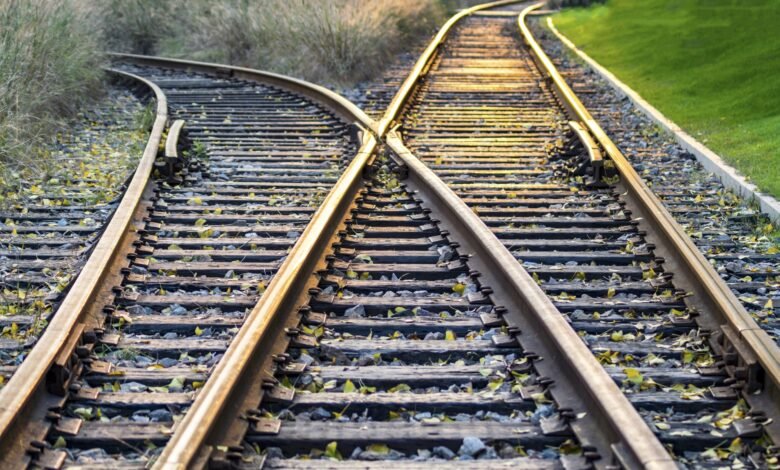
The planned section of approximately 43 km through Syunik is intended to connect mainland Azerbaijan with Nakhchivan and, beyond it, Turkey. It runs close to the Iranian border. TRIPP offers a different model for organising transport links from the Russian role in overseeing them envisaged in the 2020 statement. This is where the interests of the US, the EU, Russia, Iran, Turkey and Azerbaijan converge.
In this publication, “price” refers to the short-term (1–3 years) and long-term (10 or more years) effects on Armenia under four scenarios, ranging from a signed peace treaty and a completed route to a divergence between the US and the EU. Some costs have already materialised. Russia has imposed trade restrictions, while the EU has proposed temporary preferences. Their budgetary cost is not equivalent to the benefit to Armenian exporters and does not, on its own, show how far losses will be offset.
How to read this publication. Each thematic section ends with a three-column table: the challenge (what is happening or may happen), the question (what Armenia needs to decide or establish in advance), and the expected response (what we believe the authorities, businesses and external partners are likely to do given the existing incentives). The checklist draws on open sources; the forecasts are our assessments, not observations. “Likely” indicates supporting facts and recurring incentives; “possible” denotes a plausible hypothesis without direct evidence.
What is on the table: a long-term project and several EU support instruments
TRIPP is a long-term project whose full financing remains an open question. The EU’s response to restrictions on Armenian exports includes temporary trade preferences, direct financial assistance and separate infrastructure programmes. These are distinct instruments: they cannot be assessed solely by the value of duties waived or added together without checking for overlap. Their practical impact depends on logistics, compliance and demand. The procedural status below is as of 20 September 2026.
|
Parameter |
TRIPP |
Temporary EU trade measures |
|---|---|---|
|
Substance |
A 43 km route through Syunik: railway and road, with possible pipelines, a fibre-optic line and electricity networks |
Suspension of duties on approximately 80% of Armenian exports to the EU (324 product lines) |
|
Structure / duration |
TRIPP Development Company: 74% US ownership and 26% Armenian ownership; Armenia’s stake rises to 49% upon an agreed extension after the first 49 years. A number of key decisions require mutual consent [5] |
Two years from entry into force |
|
Funding |
According to a Carnegie assessment published in March 2026, approximately $400 million in financing had been identified by the end of 2025; the railway section was estimated to cost $250–400 million. This does not confirm full financing for all the infrastructure |
Estimated customs revenue forgone over two years: €6.6 million before deducting collection costs and approximately €5.44 million in net losses to the EU budget; tariff-rate quotas for eight agricultural products [1] |
|
Status as of 20 September 2026 |
The framework agreement was signed in June; on 16 September, the Constitutional Court found its obligations consistent with the Constitution. The next steps are parliamentary ratification and finalising the corporate documents |
The Council of the EU agreed its position on 2 September; the European Parliament approved the measures on 15 September. Parliament’s vote should not be equated with entry into force: the procedure must be completed and the measures officially published |
|
Conditions and limitations |
Armenia retains border, customs, migration and tax control |
Rules of origin, no new restrictions on imports from the EU, and compliance with CEPA principles |
The duty-free quotas for plums and apricots correspond to approximately 13% and 16%, respectively, of Armenia’s exports of these products in 2025. These are limits on preferential imports, not a ban on exports above the quota. The current tariff measures are a separate temporary mechanism and do not constitute the entirety of EU support [1].
In addition to the preferences, the European Commission announced a €52 million assistance package. Of this, €34 million was disbursed on 19 June 2026 to mitigate the impact of Russian trade restrictions on the private sector. In its statement of 2 July, the Commission announced the forthcoming release of the remaining €18 million; the statement itself does not confirm that the funds were disbursed. This package should be accounted for separately from estimated EU customs revenue forgone. Comparing European support with Armenian businesses’ losses therefore requires data not only on tariffs, but also on funds actually received and how they were distributed [14, 15].
Armenia’s price for TRIPP also includes its own obligations. Under Article 6 of the agreement, it bears the cost of securing state ownership of the necessary land and clearing it of encumbrances and third-party rights. Article 9 provides specific tax exemptions. Under Article 5, US assistance in securing financing is subject to the availability of funds and applicable requirements [5].
The US majority stake does not mean it can decide every issue unilaterally. Article 3 requires mutual consent on a number of matters involving control, major financial decisions, concessions and national security; the details are left to the charter and shareholders’ agreement. Assessing the project therefore requires examining not only ownership stakes, but also each party’s powers, dispute-resolution arrangements and financial obligations [5].
Checklist: TRIPP obligations and governance
|
Challenge |
Question for Armenia |
Expected response (our assessment) |
|---|---|---|
|
Land costs and tax exemptions [5] |
What budgetary costs will arise before transport operations begin, and how much tax revenue will be forgone |
The estimates will likely need to be refined for individual sections and projects |
|
A 26% stake in the company does not mean the budget receives 26% of all transit revenue |
Which revenues will accrue to the company and which to the budget, and which costs will be deducted before dividends are paid |
The budgetary impact may differ substantially from the project’s revenue |
|
Decisions requiring mutual consent need to be specified in detail [5] |
Which decisions can Armenia block, and how will deadlocks be resolved |
The corporate documents will likely determine the practical significance of these rights |
The price already paid: Russia applies pressure through different channels
Russian pressure and disputes with Moscow are evident in four areas: trade, the choice of customs regime, ownership and security. The explanations offered and the targets of criticism differ across these areas.
|
Channel |
Action taken |
Who is identified as the adversary |
|---|---|---|
|
Trade (restrictions announced on 11 June 2026) |
Restrictions on imports of products subject to plant quarantine controls, including fruit and vegetables, berries and nuts, forest products, coffee and cocoa; from 12 June, also on their transit through Russia to other EAEU countries [1, 7] |
No one: the stated reason is pests (Rosselkhoznadzor) |
|
Legal ultimatum (April 2026) |
Moscow states that membership in two customs unions is incompatible; in April, Vladimir Putin compared Armenia’s Russian gas price of $177.5 per thousand cubic metres with prices above $600 in Europe. This is a comparison made in a statement, not a uniform market quotation |
Armenia’s choice; no accusations against the US or the West |
|
Ownership (the nationalisation process involving Electric Networks of Armenia) |
The Russian side describes the Armenian authorities’ actions as politically motivated; the introduction of new management does not establish that the transfer of ownership is complete [8] |
A domestic political rival; the West is not named |
|
TRIPP (June–September 2026) |
Russian statements questioning the reliability of US commitments and suggesting a possible US military or intelligence presence; this is one party’s position, not an established feature of the project |
The US and “the West” are explicitly named |
The figures show the scale of the risk. Russia accounted for approximately 35% of Armenian exports in 2025 (around $3 billion), compared with 7.9% for EU countries. Published reports put trade with Russia in January–May 2026 at $2.196 billion, against $2.763 billion a year earlier: a decline of approximately 20.5% based on those amounts. Russia’s share of Armenia’s total trade fell from 35.1% to 28%. The same reports also give a decline of 21.5%, which is inconsistent with the stated amounts. The data cover the period before the June restrictions and do not measure their effects [9].
The pattern appears to be this: on trade and ownership, Moscow explains its actions in technical or domestic political terms, while explicitly referring to the American presence only in the security context. Our explanation for this distinction is an interpretation, not a proven fact; it likely reflects the legal incompatibility of the EAEU and the EU and caution in relations with Washington.
Checklist: Russian pressure
|
Challenge |
Question for Armenia |
Expected response (our assessment) |
|---|---|---|
|
Restrictions on imports of certain categories of Armenian products and their transit through Russia to other EAEU countries |
Where will products without a buyer in Russia go, and who will cover the gap until new routes become available |
The authorities will likely limit their response to targeted subsidies and talks with Rosselkhoznadzor; reorientation towards the EU will proceed more slowly than losses accumulate in the Russian market |
|
An ultimatum over the incompatibility of EAEU membership with membership in a customs union with the EU |
Does Armenia have a scenario and timetable for choosing its customs regime |
Yerevan will likely postpone a formal choice, while Moscow links individual measures—gas, bans and transit—to it |
|
The ownership dispute: nationalisation of Electric Networks of Armenia and discussion of the railway concession |
Are the government and companies prepared for Russian legal and economic responses concerning assets |
Moscow may opt for legal and economic responses rather than force; the sources reviewed provide no direct confirmation |
|
Statements about possible US troops, private military companies and intelligence operations |
How will Armenia demonstrate that it retains border and customs control, and who is responsible for protecting the route |
Explaining the agreement’s already published terms and holding parliamentary debate will likely resolve some questions, but will not end political disputes [5] |
Logistics: a bottleneck that neither preferences nor subsidies can eliminate
EU preferences open the market, but the goods still have to reach it. According to the assessments reviewed, this is where Armenian exports face constraints involving cost, delivery times, the cold chain and certification.
|
Supply-chain link |
What the sources show |
|---|---|
|
Cost and delivery time in the 2023 study |
For the supply chain examined by MB Consulting: $4 579 per container and 20 days for the entire route. The study’s model associates a 1% reduction in logistics costs with a 0.24% increase in food and alcohol exports; this is a model estimate, not a guaranteed outcome [2] |
|
Route and transit |
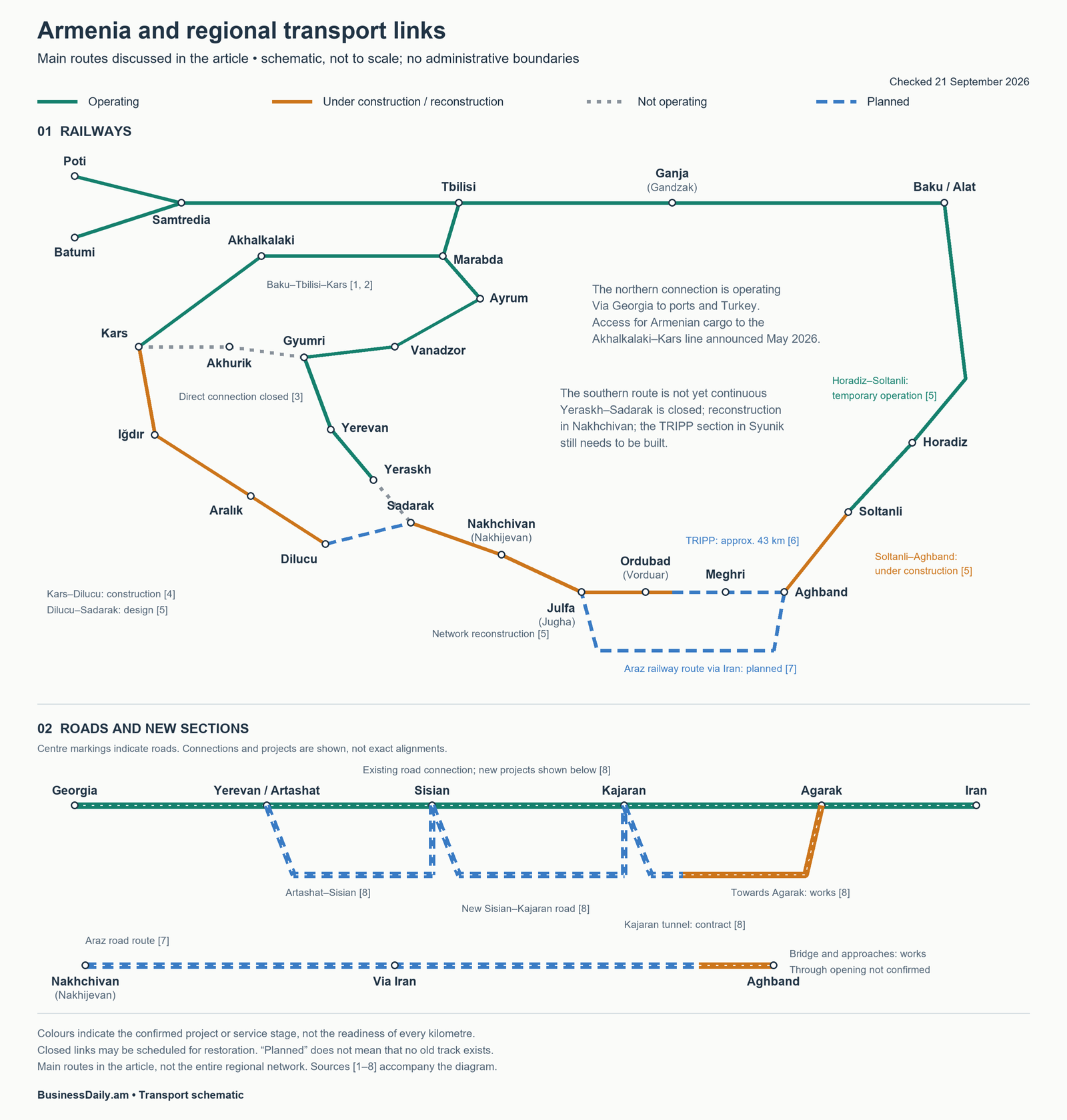
Opening a direct border, transit through third countries and access to a regular service must be distinguished. In November 2025, a train reached Armenia via Azerbaijan and Georgia; on 24 August 2026, Nikol Pashinyan described this route as open for imports and exports. Access to the Akhalkalaki–Kars line for Armenian cargo was also announced in May [6, 16, 17] |
|
Cold chain |
The 2023 study identified limitations on refrigerated rail transport to Poti and deficiencies in the cold chain. These findings are not an inventory of equipment available in September 2026 [2] |
|
Air freight |
The 2023 study describes one cargo flight per week to Liège, carrying approximately 20 tonnes, air freight costs 4–5 times higher than road transport, and a small share of freight carried by air. Current schedules and rates need to be checked with carriers [2] |
|
Certification |
For each product, the required tests, available accredited laboratories and conditions for accepting results must be identified. GLOBALG.A.P. certification alone does not replace compliance with EU requirements for a specific consignment |
|
Comparison with Russia |
Delivery costs and times depend on the product, route, season and consignment size. Europe and Moscow should be compared under equivalent transport conditions; there is no single ratio applicable to all Armenian exports |
The reopening of transport links began before TRIPP. In his address to the European Parliament on 11 March 2026, Nikol Pashinyan reported that a train had arrived via Azerbaijan and Georgia in November 2025. In his August address, he linked the partial lifting of the blockade to this route and access to the Akhalkalaki–Kars line. This does not mean that all direct border crossings have opened. Businesses need confirmed volumes, schedules, rates and access conditions for specific cargoes, not just a political announcement [16, 17].
Routes and their readiness
|
Route |
What has been confirmed or announced |
What still needs to be checked |
|---|---|---|
|
Via Azerbaijan and Georgia to Armenia |
The prime minister reported the arrival of a train in November 2025; in August 2026, he stated that the route was available for imports and exports [16, 17] |
Service frequency, volumes, rates and access conditions for individual types of cargo |
|
Akhalkalaki–Kars via Georgia and Turkey |
Access for Armenian imports and exports was announced in May 2026 [6, 17] |
Availability of a specific service and its full cost, including transshipment and delivery to the buyer |
|
Direct links through Syunik and Nakhchivan |
TRIPP and the restoration of other links remain separate projects and arrangements [5, 17] |
Construction of missing sections, border procedures and operating conditions |
Transport schematic
Cargo consolidation is a separate problem. The Yerevan and Syunik customs and logistics centres are envisaged as infrastructure expansion projects; the Syunik project near Shaki is estimated at €14.4 million. This does not mean that no private sorting, packing or cold-storage capacity currently exists. Back in 2023, MB Consulting proposed a digital freight platform, a regular container train to Poti and expanded air services [2, 10, 11].
In July 2026, a support package worth approximately 5 billion 366 million drams was presented. A separate draft government decision provides for reimbursing airlines for 50% of the calculated aviation fuel cost of carrying Armenian-origin cargo on new routes. The eligible fuel price is capped at 550 thousand drams per tonne, making the maximum reimbursement 275 thousand drams per tonne. The draft’s explanatory note estimates expenditure in 2027–2028 at approximately 3 billion drams. This is a draft estimate, not confirmation that funds have already been allocated. The measure may reduce costs on individual flights, but it does not solve the entire consolidation problem. In our assessment, small producers will struggle to fill containers and flights without pooling consignments [3].
The North–South road corridor has significance in its own right. The EBRD envisages a sovereign loan of up to €236 million for a 24-kilometre southern section of the Sisian–Kajaran road. The expected reduction in distance from 130 to 60 km and journey time from 3–4 hours to one hour applies to the new Sisian–Kajaran connection as a whole, not just these 24 km. The project improves Syunik’s internal links with the rest of Armenia and its access through Georgia and Iran, regardless of whether TRIPP is completed. Its benefits must be assessed alongside the future debt burden: a loan is not a grant [18].
Checklist: logistics
|
Challenge |
Question for Armenia |
Expected response (our assessment) |
|---|---|---|
|
In the 2023 calculation, the entire route costs $4 579 and takes 20 days; the initial overland leg and handling in Poti together account for approximately $1 578 and 7 days, or 34.5% of the cost and 35% of the time. This stage includes Georgia [2] |
What can be done before new routes become available: a regular container train to Poti, standardised documentation and more services |
Consolidated shipments will likely first attract demand for higher-value goods; the profitability of transporting vegetables depends on the season, price, losses and capacity utilisation |
|
A partial reopening has already begun: routes via Azerbaijan and Georgia are available, and access to the Akhalkalaki–Kars line has been announced. TRIPP still needs to be implemented [6, 16, 17] |
What should be done if TRIPP does not provide an export route by 2030 |
Routes through Georgia will likely retain a key role; delays to TRIPP do not negate opportunities already available. The scale of additional exports and transit revenue requires a separate calculation |
|
The 2023 study identifies constraints on the cold chain and air cargo services; current availability of refrigerated transport and flights must be checked separately [2] |
Who will pay for refrigerated transport equipment and cold stores, and who will own them |
The EU and the EBRD may cover some of the cost through the centres, including the Yerevan centre, but private businesses will not invest without guaranteed volumes |
|
Support for individual transport costs does not, by itself, guarantee the consolidation of small consignments |
Will subsidies be redirected towards funding consolidated consignments |
This is likely the fastest solution within the existing budget; it is politically sensitive because intermediaries, rather than individual producers, would benefit |
|
The North–South road is being developed as an independent project [18] |
What improvements will be available if TRIPP is delayed, when will they enter service, and what debt burden will they entail |
Gradual improvements to domestic roads will likely reduce some transport costs, but will not replace agreements on access to external routes |
Market access does not automatically translate into sales. For a specific product, it is necessary to establish the buyer, purchase price, season, minimum consignment size, payment terms and margin remaining after transport, certification, storage and losses. Assessments of export reorientation must therefore rest on confirmed commercial demand as well as technical readiness.
Checklist: consolidation
|
Challenge |
Question for Armenia |
Expected response (our assessment) |
|---|---|---|
|
The Yerevan and Syunik centre projects are intended to expand consolidation infrastructure; operating private facilities already exist [10, 11] |
Who will act as the consolidator—the state, cooperatives, a private aggregator or a freight forwarder—and who will bear the risk |
Private aggregators and freight forwarders will likely move first: they are faster and do not require a new law; cooperatives will join later |
|
According to a published report, exports to the EU exceeded $516 million in the first half of 2026, growing by more than 80%; the report provides no breakdown by product |
Which products drove the growth, and which routes did they take |
Growth may have come from goods that do not require a complex supply chain, such as dry or processed products |
|
Fragmented production and distrust of pooled consignments |
What prevents small farmers from joining forces: working capital, trust or a common standard |
Payment arrangements and trust will likely prove to be the main obstacles, rather than a lack of warehouses |
|
Possible models: a cold store in the Ararat Valley, consolidated freight services, an aggregator or a 3PL warehouse in Georgia |
Which should be piloted first |
Consolidated services run by freight forwarders and a warehouse in Georgia may be the quickest to launch: they require less investment but entail dependence on Georgian infrastructure |
|
Preferences and available transport do not, by themselves, guarantee sales |
Are there confirmed buyers and a positive margin after all costs, including losses and deferred payment |
Sustained deliveries will likely begin with a limited range of products and buyers; scaling up will require repeat orders |
Checklist: finance and law
|
Challenge |
Question for Armenia |
Expected response (our assessment) |
|---|---|---|
|
Whether existing legal forms and mechanisms are sufficient for producer organisations and warehouse receipts requires a separate legal assessment |
Is Armenia prepared to adopt a law and establish a register before large-scale exports to the EU begin |
Some tasks can likely be addressed through existing legal forms; the need for a new law depends on the legal gaps identified |
|
Guarantees and insurance are not tied to consolidation |
Who will assume the risk of advances to farmers and the consolidator’s working capital: banks, the Export Insurance Agency or a donor |
Donor risk-sharing arrangements, such as those involving the EBRD and Acba Bank, will likely expand before state guarantees do |
|
Agricultural cooperatives: a 2015 law, 176 cooperatives and 141 collective farms at the end of 2024 |
How can individual farms, existing cooperatives and collective farms be helped to pool consignments and enter export markets |
Both channels may be needed, and the instruments will have to be adapted to private aggregators |
|
The procurement loan programme provides interest-rate subsidies and state guarantees; its terms and limits must be checked against the borrower category and the purpose of the loan |
Do cooperatives and cold stores use these instruments |
Assessing coverage requires data on actual recipients. The absence of the word “cooperative” from a brief programme description does not, in itself, establish that support is unavailable |
Checklist: certification and origin
|
Challenge |
Question for Armenia |
Expected response (our assessment) |
|---|---|---|
|
REX registration is provided for as an option for making a statement on origin; preferences may be suspended in the absence of administrative cooperation (COM(2026)348) |
Who verifies evidence of origin |
Large exporters will likely register quickly; the risk of suspension will arise with the first EU checks |
|
The procedure for exporting fish to the EU was approved in July 2026 |
Are existing phytosanitary procedures and laboratory capabilities sufficient to expand fruit and vegetable exports |
Additional organisational measures may be needed for individual crops. The existence of a separate procedure for fish does not mean that rules for fruit and vegetables are absent |
|
According to Economy Minister Gevorg Papoyan, Armenian fruit and vegetables intended for export have GLOBALG.A.P. certification. He did not specify a percentage. This is a ministerial statement, not an independent assessment of coverage; mandatory EU requirements for specific products must be checked separately [4] |
Which laboratories are accredited, and does the EU recognise their results |
Timeframes and costs depend on the type of testing and the accreditation in force. Where suitable local capabilities are unavailable, exporters may turn to laboratories abroad |
|
Rosselkhoznadzor refers to a “lack of effective control” |
How can the effectiveness of quality control be demonstrated independently |
The dispute will likely remain political: independent quality data are unlikely to be published quickly |
|
Consignment traceability and origin requirements matter for exports; the EU supports the development of a geographical indication for Armenian brandy |
Who maintains consignment records and checks suppliers’ incoming goods at the consolidator, and which varieties and territories will receive a GI |
Introducing shared digital records may require external support; the brandy project cannot establish when geographical indications for fresh fruit might emerge |
What Armenia can do on its own and what requires external assistance
Armenia can design logistics and certification arrangements itself, but is unlikely to implement them at the necessary scale and secure EU recognition without external assistance. This is our assessment based on the available data, not an established fact.
|
Type of measure |
Can Armenia act on its own |
Basis and qualification |
|---|---|---|
|
Laws and procedures: legal forms for producer organisations, warehouse receipts, and registration of exporters and establishments |
Yes |
The government can approve implementing procedures within its powers; parliament is required where legislation must change. These two levels of decision-making should be distinguished |
|
Redirecting subsidies towards funding consolidated consignments |
Yes, within the budget |
The 5.4 billion dram package is approximately 0.15% of the 2026 budget’s 3.6 trillion drams in expenditure (our calculation); the 537 billion dram deficit limits the scale |
|
Private logistics services |
Yes |
Logistics providers are ready to arrange delivery, but cost and certification remain barriers |
|
State guarantees and risk-sharing |
Partly |
The procurement loan programme includes state guarantees. A separate €50 million EBRD–Acba Bank facility supports the private sector as a whole; it should not be treated as dedicated agricultural logistics funding |
|
Cold stores, refrigerated transport equipment, and customs and logistics centres |
With external capital |
The Syunik centre: a cost of €14.4 million, with a 10 million loan and 2 million in grants from the EBRD, alongside government co-financing |
|
Geographical indications |
Partly |
The EU is funding a €2.845 million project to develop a geographical indication for Armenian brandy. Developing the specification and registering the name are separate stages; the project does not confer the right to use the protected name Cognac |
|
Laboratories and EU recognition of results |
Partly |
Armenia can develop testing capacity and accreditation; the acceptability of specific results is determined by the applicable EU requirements and the conditions of the relevant procedure |
|
A route through Turkey |
No (Ankara decides) |
Access depends on Turkish rules and the type of transport. In May 2026, the opening of the Akhalkalaki–Kars line to Armenian exports and imports via Georgia was announced [6] |
Checklist: winter energy security
|
Challenge |
Question for Armenia |
Expected response (our assessment) |
|---|---|---|
|
A scenario in which the gas pipeline stops operating for 10–15 days in winter |
Is there a contingency plan for such a winter interruption: reserves, Iranian gas and prioritisation of consumers |
Any shortfall depends on actual reserves, withdrawal rates, weather and available alternative supplies. Without this balance, inadequate reserves cannot be treated as an established fact |
|
A price increase through termination of the 2013 agreement on duty-free supplies |
Who will pay the difference: consumers, the budget or partners |
The shock will likely be cushioned in stages; the Central Bank described such a scenario as “apocalyptic” and provided no figures |
|
A complete cut-off |
Which volumes and routes could replace Russian gas |
Rapid, complete replacement may prove difficult. An assessment requires confirmed spare capacity, volumes, prices and supplier agreements. Railway project schedules do not determine the timing of possible gas supplies |
|
The condition is linked to “moving towards the EU”, rather than trade measures |
How will Armenia describe its policy course to avoid giving grounds for revising the terms |
The rhetoric will likely remain cautious: “trade measures”, rather than “accession” |
Four scenarios: who controls the hub
In our assessment, “frozen peace” is among Armenia’s riskiest long-term scenarios: uncertainty may close off investment opportunities. However, a delay to TRIPP does not mean that all previous isolation remains intact: some links have already opened, while independent road projects may continue. The scenarios below should therefore be compared against this changing baseline. This is our assessment, not a probability-based forecast.
|
Scenario |
What needs to happen |
Horizon: 1–3 years |
Horizon: 10+ years |
|---|---|---|---|
|
1. Peace and a corridor |
Ratification, the constitutional process, the signing of a peace treaty, and financing for the route by 2028–2030 |
The loss of the Russian market hurts most; EU measures provide a partial offset; construction begins |
Regional connectivity expands; Armenia may strengthen its role as a hub. Its 26% stake rises to 49% upon an agreed extension; the risk is becoming a frontline area |
|
2. Frozen peace |
The constitutional process stalls, Baku does not sign, and TRIPP progresses slowly |
Some previously opened routes continue to operate; Russian restrictions remain. Direct revenue forgone from TRIPP must be calculated, rather than assumed to be small |
Some cargo may shift to other routes. The bypass through Iran must be distinguished from competition between Yeraskh–Akhurik and Dilucu–Kars: their effects depend on the specific flows, rates and access conditions [17, 19] |
|
3. An external shock |
Escalation involving Iran and/or another round of Russian pressure involving gas, the railway or transit |
Escalation involving Iran may seriously disrupt or halt construction; risks to Syunik’s economy rise sharply |
The project is virtually impossible without stability in the south |
|
4. Reversal and US–EU divergence |
A change of US administration after 2028 or deteriorating relations between Washington and Brussels |
If the envisaged structure is implemented, the US will hold 74% of TRIPP Development Company; the EU will continue to use separate trade and financial instruments |
Armenia may find itself between two centres of power with different requirements |
Checklist: challenges and responses by scenario
|
Scenario and early indicators |
Main challenge |
Question for Armenia |
Expected response (our assessment) |
|---|---|---|---|
|
1. Peace and a corridor. Indicators: ratification, a shareholders’ agreement and constitutional amendments; Pashinyan’s party lacks a two-thirds majority |
Syunik’s role as a frontline area; Russian and Iranian pressure; Iran’s red lines: no extraterritorial status for Syunik and no US military presence |
Which guarantees of sovereign control and security are in place before construction begins, and who provides them |
The government will likely negotiate with the US, the EU, Iran and Baku simultaneously; the main constraint is the constitutional procedure |
|
2. Frozen peace. Indicators: Baku does not sign the initialled treaty, ratification drags on, and construction does not begin |
Alternative routes may reduce the future role of Armenian sections, but already opened links and independent projects remain important [17, 18, 19] |
Which decisions do not depend on Baku and are needed in any case: logistics, certification and gas |
The authorities will likely continue reforms and trade with the EU, while major projects are postponed |
|
3. An external shock. Indicators: escalation involving Iran, reduced gas supplies and new Russian bans (Moscow Times) |
A simultaneous blow to the southern route through Meghri and to the energy sector |
What must be preserved at a minimum: winter gas supplies, export markets and Syunik’s security |
Crisis measures—reserves, compensation and a search for gas—and requests for external assistance are likely; TRIPP will effectively be frozen |
|
4. Reversal and US–EU divergence. Indicators: a change of US administration after 2028, differing US and EU conditions, and suspension of EU trade measures under safeguard provisions |
Long-term TRIPP commitments and potentially diverging partner requirements; the agreement also provides a termination procedure with one year’s notice [5] |
Which terms of TRIPP and the trade measures can be changed, and which should be fixed for both partners |
Yerevan may seek formulas acceptable to both; it is unlikely to prevail in a dispute |
Competing and complementary routes
The broad phrase “alternative lines” encompasses different projects. The Araz route through Iran is intended to connect mainland Azerbaijan with Nakhchivan, bypassing Armenia. An official Azerbaijani source describes an intergovernmental memorandum and infrastructure works that have begun; this does not confirm that the entire road and rail connection is ready. For Armenia, the question is which specific flows this bypass could attract and on what terms [19].
A different form of competition arises between the Yeraskh–Akhurik and Dilucu–Kars lines: Pashinyan explicitly identified it on 24 August. In the same address, he described an Iran–Nakhchivan–Armenia–Georgia connection as a separate possible outcome of reopening regional links, rather than part of TRIPP itself. The Turkish line, the Iranian bypass and restoration of Armenia’s network should therefore not be merged into a single claim that Armenia is losing its significance: they concern different sections and directions of freight movement [17].
Who gains and who loses: reality and narrative
TRIPP changes the distribution of leverage around Syunik, but does not “cut off” Russia, Iran and China from one another: according to the sources reviewed, the real effect is a loss of control over the hub, not physical isolation.
|
Actor |
What is substantiated |
What is narrative or remains unconfirmed |
|---|---|---|
|
Russia |
Implementation of the route may reduce Russian influence over transport links in Syunik. This does not mean physically blocking Russia’s links with Iran or an absence of other routes |
“American troops or private military companies and intelligence operations” is one party’s claim, unconfirmed by the sources reviewed; the agreement leaves border and customs control with Armenia |
|
Iran |
Loses influence over Azerbaijan–Nakhchivan traffic; proposes a reciprocity formula and supports the project subject to conditions; its red lines are no extraterritorial status for Syunik and no US military presence |
The claim that Iran is being “cut off” does not follow from the project’s geography. Tehran’s position depends on guarantees of Armenian sovereignty and the nature of the external presence |
|
China |
The Middle Corridor carried 4.1 million tonnes of cargo in 2024. This cannot be directly compared with another route’s planned capacity; constraints include port infrastructure and transport across the Caspian Sea [12] |
The sources reviewed do not establish any direct dependence of China on Armenia |
|
Turkey |
Is building the new Kars–Dilucu line: 224 km, approximately €2.4 billion, with completion around 2030 |
Competition between Yeraskh–Akhurik and Dilucu–Kars depends on rates, service quality and access conditions; Pashinyan drew this comparison on 24 August [17] |
|
Azerbaijan |
Wants a direct connection to Nakhchivan through Armenia. Baku links the signing of a peace treaty to changes in Armenia’s constitution; this is the Azerbaijani side’s demand |
Interest in the route does not equate to readiness to sign the treaty: the agreement initialled in August 2025 remains unsigned |
The implication for Armenia: the same hub that makes it valuable to the US, the EU and Azerbaijan also makes it vulnerable to Russia and Iran. The higher the stakes, the greater the risks to Armenia itself as a borderland.
Summary checklist and main conclusion: manage the price of the hub, rather than choose a side
Armenia stands to gain more by turning Syunik from an arena of great-power competition into a hub serving multiple interests than by staking everything on a single patron. This is our conclusion from the facts gathered, not the position of any party.
Do not stake everything on TRIPP. Future transit revenue, budgetary obligations and the adequacy of financing must be calculated. Armenia should use links that have already opened and continue independent projects, including North–South. Increasing exports to the EU, whose share stood at 7.9% in 2025, requires competitive logistics, compliance, confirmed buyers and a positive margin. Direct EU assistance must be accounted for separately from tariff preferences.
Maintain several sources of support. The US, the EU, Iran’s proposed reciprocity formula and negotiations with Baku reduce dependence on a single centre of decision-making.
Understand the cost of non-completion. Before ratification, Armenia needs to know what costs and obligations it will bear if the corridor remains on paper, who will protect the route, and how joint decision-making mechanisms will work. Assessments of benefits must distinguish company revenue, dividends and budget revenue.
Monitor three groups of indicators: legal decisions—ratification and corporate documents; implementation—financing, construction and the availability of transport services; and commercial results—buyer contracts, sustained volumes and revenue after expenses.
Sources for key factual clarifications
1. European Commission. Proposal for temporary trade measures and financial annex, 2 July 2026 Source
2. MB Consulting. Study of Armenian export logistics, 2023; Table 7 Source
3. Draft air cargo support programme: terms and explanatory note Source
3a. Estimated budget expenditure for the air cargo programme Source
4. Public Radio of Armenia. Gevorg Papoyan’s statement on GLOBALG.A.P. Source
5. Ministry of Foreign Affairs of Armenia. Text of the TRIPP framework agreement, published on 26 May 2026 Source
6. RBC. Announcement of the opening of the Akhalkalaki–Kars line to Armenian cargo, 24 May 2026 Source
7. Public Radio of Armenia. Restrictions on product imports and transit, 12 June 2026 Source
8. ARKA. September draft concerning the transfer of shares in Electric Networks of Armenia Source
9. RBC. Russia–Armenia trade in January–May 2026; the percentage in the report is inconsistent with the stated amounts Source
10. BellyBella. Existing private sorting, packing and storage facilities Source
11. EBRD. Syunik Customs and Logistics Centre Source
12. Carnegie. The Middle Corridor and constraints on its development, April 2026 Source
13. Carnegie. TRIPP and transport infrastructure financing, March 2026 Source
14. European Commission. Disbursement of €34 million in assistance to Armenia, 19 June 2026 Source
15. European Commission. The €52 million package and announcement of the forthcoming release of the remaining €18 million, 2 July 2026 Source
16. Prime Minister of Armenia. Address in Strasbourg, 11 March 2026 Source
17. Prime Minister of Armenia. Address during discussion of the government programme, 24 August 2026 Source
18. EBRD. North–South Road Corridor, Sisian–Kajaran, project No. 51293 Source
19. President of Azerbaijan. Official description of transport projects, including the Araz route through Iran Source
Sources for the schematic
- [1] South Caucasus Railway
- [1] Georgian Railway
- [2] Prime Minister of Armenia · 24.08.2026
- [3] MFA Armenia · 28.04.2026
- [4] Kalyon · Kars–Dilucu
- [5] President of Azerbaijan · 11.08.2026
- [6] Government of Armenia · 17.09.2026
- [7] Araz route
- [8] Road Department · North–South
AI tools were used in preparing the publication, translations and transport schematic.
Photo: ilovehz / Magnific