
Pashinyan at DigiTec 2026: Armenia to deliver AI services to international and regional markets via cables
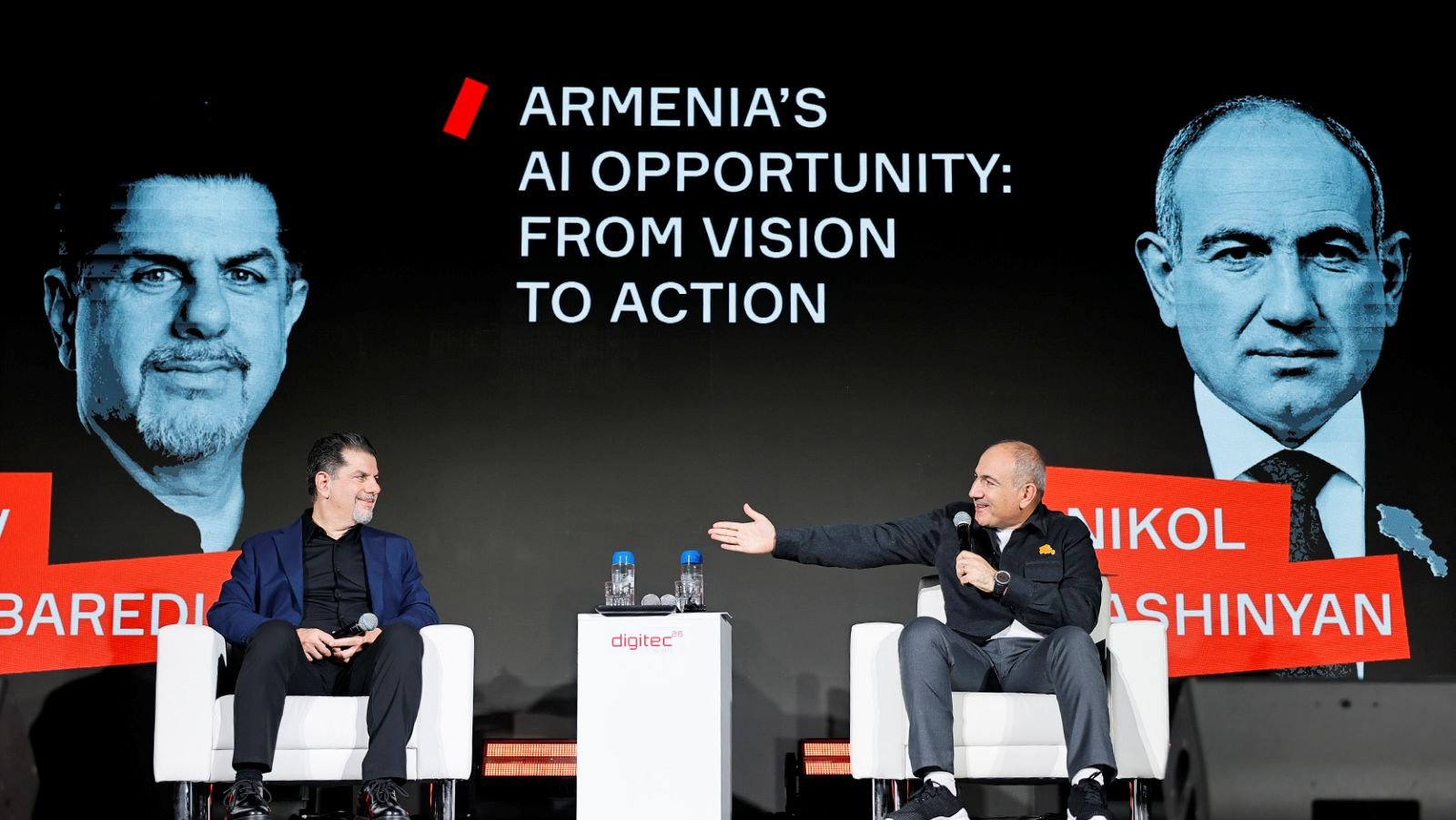
Armenia will deliver artificial intelligence (AI) services to international and regional markets via cables under the Crossroads of Peace project, Armenian Prime Minister Nikol Pashinyan said during an open discussion with NVIDIA Vice President Rev Lebaredian at the DigiTec 2026 exhibition and conference, the Office of the Prime Minister of Armenia reports. The Prime Minister invited investors to Armenia and said the launch of the TRIPP project would be officially announced in the coming days. On the sidelines of Digitec 2026, Campus Cyber (France), Armenia’s Ministry of High-Tech Industry and Artificial Intelligence and Expertise France signed a memorandum of understanding to support the creation of a Cybersecurity Campus in Armenia and strengthen cooperation in cybersecurity. The initiative is implemented with European Union support under the EU4InnovationEast programme.
What the Prime Minister said
The discussion, titled “Armenia’s Opportunities in Artificial Intelligence: From Vision to Action”, took place at the Meridian Expo Center. It was attended by Anna Hakobyan, the spouse of Armenia’s Prime Minister. The conversation focused on the strategy for turning Armenia into an AI hub and the steps to get there.
- Taxes and the budget. AI factories pay taxes and replenish the state budget, which funds, among other things, health insurance and infrastructure.
- Jobs. AI factories can help create new jobs.
- Investors. The sector faces challenges, but opportunities are growing; the Prime Minister invited investors to Armenia.
- Crossroads of Peace. AI development is linked to this project: Armenia will provide international and regional AI services via cables.
- AI in government. “Our goal will not be to replace people with artificial intelligence”: the aim is to make work more effective, primarily for public servants.
Energy and TRIPP
- Armenia is developing renewable energy, especially solar, but needs storage capacity: without it, the efficiency of solar generation would fall by roughly half.
- The launch of the TRIPP project will be officially announced in the coming days.
- Armenia’s power grid will be connected to the grids of Turkey and Azerbaijan; it is already connected with Iran and Georgia.
What Firebird’s co-founder said at DigiTec
Firebird AI co-founder Alexander Yesayan said at DigiTec 2026 that the company plans to expand the capacity of its AI data centers in Armenia to more than 300 MW by the end of 2027.
- According to him, together with other projects in the country, the goal is to place Armenia among the world’s top 10 countries in AI computing capacity.
- In the age of AI, talent alone is not enough: intellectual potential needs infrastructure, energy, computing power and data centers.
- The idea of creating a world-class AI hub in Armenia initially seemed far too ambitious but has been successfully realized.
Who benefits
- Investors and companies building AI infrastructure — the Prime Minister’s direct invitation and the grid expansion plans concern them directly.
- Energy companies — demand from AI factories and the need for energy storage create a new market.
- Startups, universities and researchers — part of the computing capacity is earmarked for them.
- Public administration — AI will be introduced to make public servants’ work more effective.
What it means
The government sees AI infrastructure not only as technology but also as a source of taxes, jobs and exports. The link to Crossroads of Peace and TRIPP means Armenia is preparing to sell computing services beyond its borders using regional connectivity. At the same time, the Prime Minister effectively acknowledged that energy is the main constraint on the sector: solar plants need storage, and the grid needs connections with neighbors.
What to do
- Investors — watch for the official announcement of the TRIPP launch, expected in the coming days.
- AI developers and researchers — attend the Firebird Cloud Platform presentation at DigiTec on 22 November, where the procedure for accessing the company’s computing resources will be presented.
- Submit comments on the draft procedure for access to the 181 state-acquired GPUs on e-draft.am by 2 December.
- Energy companies — assess the energy storage market, a need the Prime Minister named directly.
Background
The government’s goal. Davit Tadevosyan, Armenia’s Minister of High-Tech Industry and Artificial Intelligence, announced at the opening of DigiTec 2026 that the government aims to build at least 100,000 GPU-equivalents of leading-class computing capacity by 2031. He said high tech accounts for about 7% of GDP and that the capacity will be available to research organizations, universities and tech companies.
Armenia’s computing capacity.
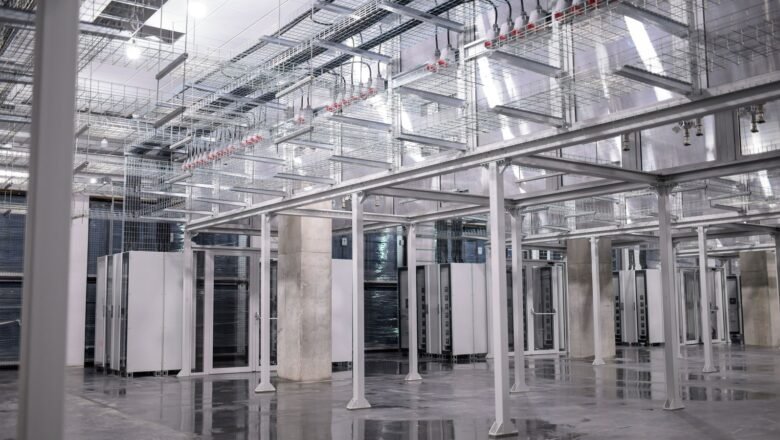
- Firebird, Hrazdan. The AI factory opened on 8 August 2026 on the NVIDIA DSX platform. Phase one: 6,144 processors, about 18 MW. More than 70,000 NVIDIA Rubin and Blackwell GPUs and 300 MW are planned by the end of 2027. A third phase could bring the total to 110,000 GPUs.
- Eleveight, Gagarin (Gegharkunik). Opened on 1 June 2026 with NVIDIA Blackwell B300 GPUs. 20% of capacity goes to Armenian universities, research centers and non-profits. The first 1.5 MW is fully contracted; 5 MW ($150 million) is planned by the end of 2026 and 40 MW in total in 2027.
- YSU supercomputer. 64 NVIDIA H100 compute modules, installed with government support.
- Aznavur supercomputer, Engineering City. A CPU-based system: 24,480 cores, 39 TB of memory, 861.7 TFLOPS peak performance.
- 181 state GPUs. The draft procedure for access to the 181 GPUs the state acquired from Firebird is open for public comment until 2 December.
Central Bank estimate. AI factories could raise potential economic growth to 6.9%. Computing capacity could grow from about 6,000 GPUs to 50,000–70,000 or more, power demand from 15–18 MW to 300–400 MW, and exports to 0.6–1% of GDP.
Physical AI programme. A seven-year programme worth about $14 million is starting at YSU, the Polytechnic University and the American University of Armenia, using the YSU supercomputer and Firebird’s capacity.
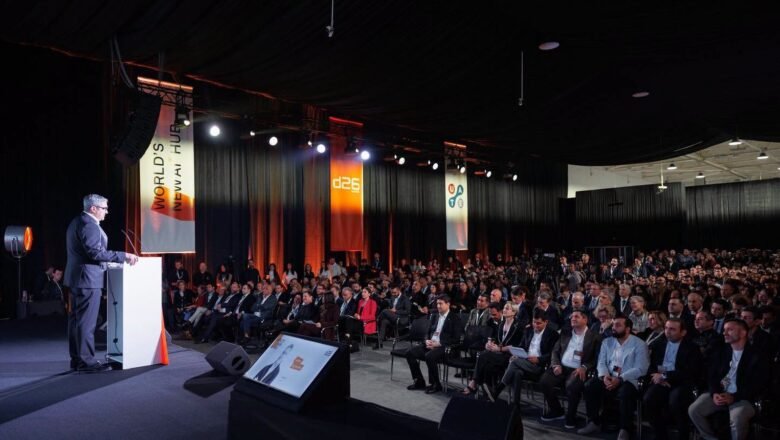
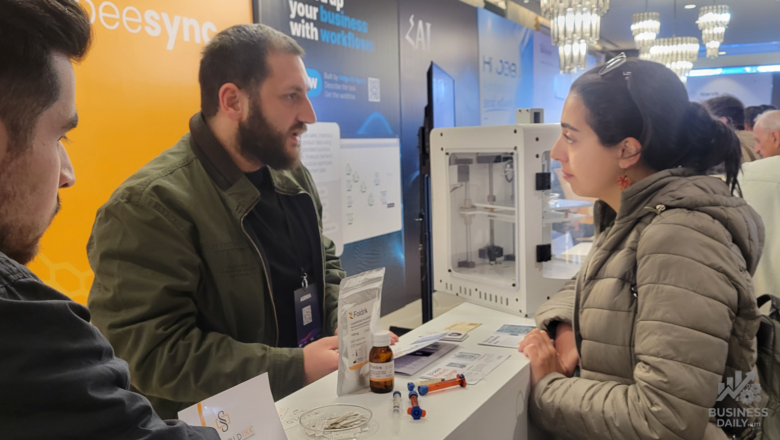
DigiTec 2026. The exhibition and conference is being held for the 21st time, on 20–22 November at the Meridian Expo Center, under the theme “The World’s New AI Hub”. It is organized by the Union of Advanced Technology Enterprises (UATE). More than 150 companies and 64 startups take part in the exhibition, and 125 speakers on three stages in the conference. The programme presented by the organizers is built around five layers of AI: energy, chips, infrastructure, models and applications.
20 November — “Capital, Energy and the Compute Race”.
- Opening ceremony, at which Minister Davit Tadevosyan presented the 100,000-GPU goal.
- Keynote by Rev Lebaredian, NVIDIA Vice President of Physical AI Simulation, on Armenia’s future in the age of AI.
- Adrian McDonald, President of Dell Technologies EMEA, on moving AI from pilots to production.
- Krisp co-founder Artavazd Minasyan on voice AI.
- Energy panel with Schneider Electric, Karpowership and others on AI’s power constraints.
- On the DigiHub stage: sessions by OpenAI, Krisp and TUMO, and the launch of the Armenia Ecosystem Platform.
- ArmRobotics national championship hackathon.
21 November — “Data, Silicon and Machines”.
- Talk by Oculus co-founder Jack McCauley.
- Dell, Firebird, Netris and Schneider Electric presented the five layers of AI.
- Firebird co-founders Alexander Yesayan and Razmig Hovaghimian on building an AI factory in Armenia.
- AMD, Synopsys and Microchip on chips for physical AI.
- Discussion between Prime Minister Nikol Pashinyan and Rev Lebaredian.
- Ali Agha of FieldAI on robotics; Naira Hovakimyan of Kestrel Robotics on safe autonomy in the air and in space.
- Closing talk by Mozilla CTO Raffi Krikorian.
- ArmRobotics national championship final on the theme “Smart Robots in an AI Factory”: teams were selected from a record 180 applications.
- On DigiHub: NVIDIA’s presentation on Nemotron models, panels on computing capacity, science and industrial AI.
- The programme also included the signing of a memorandum of understanding on the Armenian Cyber Campus.
22 November — “Applications and Governance”.
- AWS talk on real-world applications of generative AI.
- Cybersecurity panel with Campus Cyber, Synergy International Systems and the Central Bank of Armenia.
- Revolut, Tabby, Comfi and Anchorage Digital on whether to build or buy models.
- NVIDIA, Agile Robots, All3 and Positronic Robotics on going from simulation to the factory floor.
- Panel on sovereignty and regional hubs, moderated by UATE President Armen Kocharyan, with Kazakhstan’s Deputy Prime Minister Zhaslan Madiyev, Armenia’s Minister of High-Tech Industry and Artificial Intelligence Davit Tadevosyan, Greece’s Deputy Minister of Foreign Affairs Harry Theoharis and Bulgaria’s Deputy Minister of Innovation and Growth Mira Yossifova.
- In an additional hall: a presentation of the Firebird Cloud Platform and how to access it, followed by six technical talks by NVIDIA engineers and researchers on autonomous driving, world models, AI-assisted mathematical discovery, Omniverse, agentic workflows and AI benchmarking.
- On DigiHub: the BANA Angels Startup Arena and AI in banking.
- Closing talk by Nobel Peace Prize laureate Kailash Satyarthi on why AI needs compassion, not just regulation.
Editor’s comment
Computing capacity plans are growing fast: Firebird alone plans more than 300 MW by the end of 2027, while the Central Bank puts the sector’s total power demand at 300–400 MW. Against this backdrop, the Prime Minister’s remarks on energy storage and grid connections with neighbors show that reaching the 100,000-GPU goal depends heavily on how quickly the energy system develops.