Armenia’s external debt reached 66% of gross national income in 2025
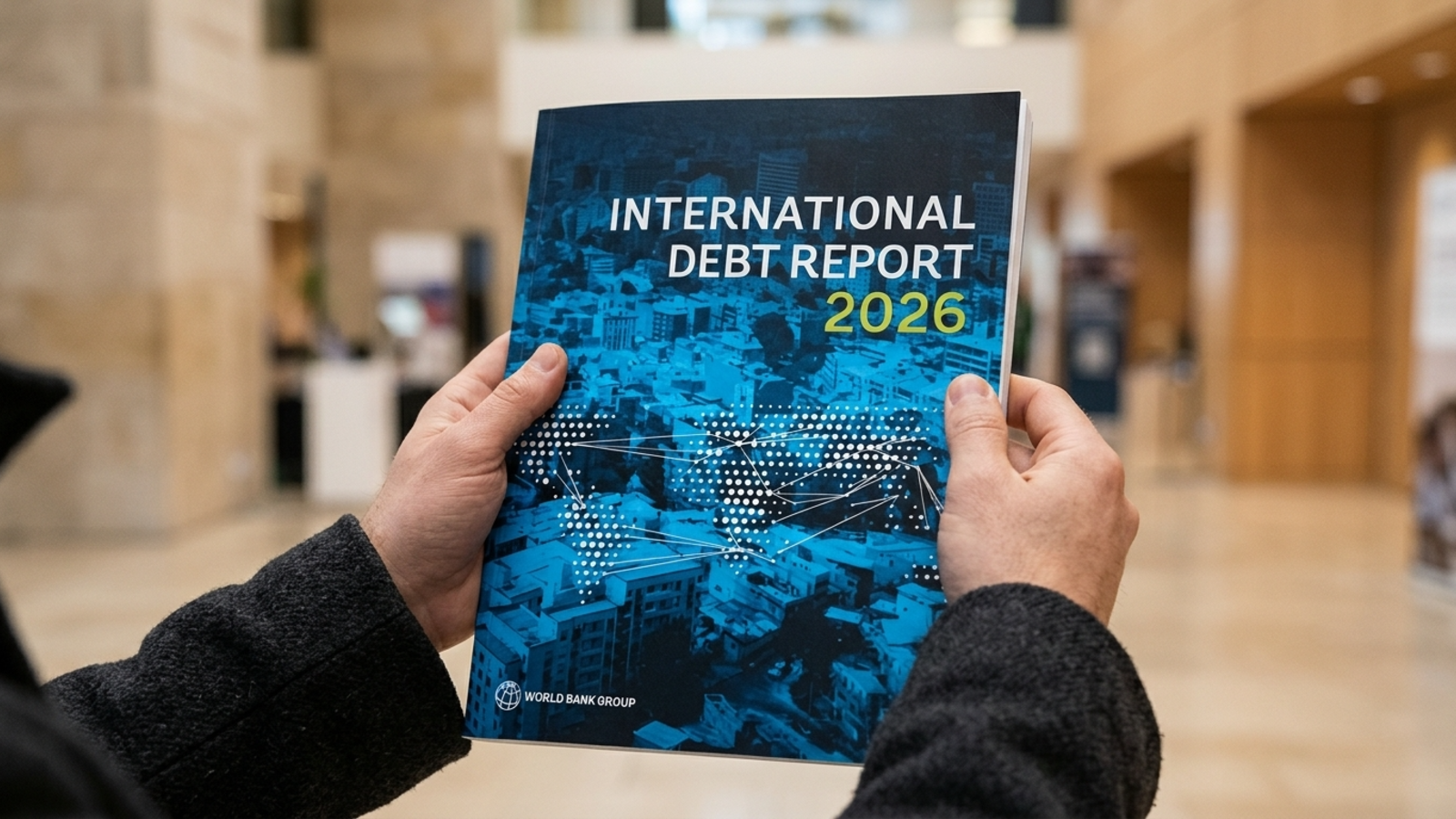
Armenia’s external debt reached $18.7 billion at the end of 2025, up 14.1% from a year earlier. According to the World Bank‘s International Debt Report 2026, debt grew fastest in Armenia among the South Caucasus countries. Georgia’s rose 5.3%, while Azerbaijan’s fell 9.3%. Armenia’s external debt equals 66% of gross national income (GNI), compared with 71% for Georgia and 17% for Azerbaijan.
External debt covers liabilities to nonresidents of the government, publicly guaranteed borrowers and the private sector. The report covers low- and middle-income countries, with data as of end-2025.
Who Armenia owes
Of Armenia’s external debt, $7.4 billion is public and publicly guaranteed, $6.5 billion is private nonguaranteed and $4.8 billion is short-term. Multilateral creditors hold $4.1 billion of the public and publicly guaranteed debt, including $1.1 billion owed to the International Bank for Reconstruction and Development (IBRD, part of the World Bank Group) and $1.1 billion to the Asian Development Bank (ADB). Bilateral creditors account for $1.2 billion, mainly France ($487 million) and Germany ($478 million), and private creditors for $2.0 billion.
Armenia’s external debt has more than doubled since 2015, from $8.8 billion to $18.7 billion.
Debt service
The ratio of external debt to exports reached 122% in 2025, 47.6% higher than in 2024. Debt service, meaning principal and interest paid, amounted to 21% of exports (up 62.3%) and 11% of GNI (up 10.8%). In the report, exports cover goods, services and primary income.
Terms of new borrowing
New loans Armenia contracted from official creditors in 2025 carried an average interest rate of 3.4%, a maturity of 23 years and a grace period of 7 years. Funds from private creditors came at 6.8% with a 10-year maturity. Georgia’s new official loans were at 2.6% over 24 years, Azerbaijan’s at 5.1% over 14 years. Neither country took on new commitments from private creditors in 2025.
Georgia and Azerbaijan
Georgia’s external debt is $25.4 billion ($14.4 billion in 2015), of which $11.2 billion is public and publicly guaranteed, $9.0 billion private and $5.2 billion short-term. All four debt ratios declined in 2025: debt to exports stands at 127%, debt to GNI at 71%, debt service to exports at 18% and to GNI at 10%.
Azerbaijan’s external debt is $12.3 billion, below the 2015 level of $13.2 billion. Public and publicly guaranteed debt makes up $11.0 billion, private $1.1 billion and short-term $222 million. Debt equals 35% of exports and 17% of GNI, and debt service 8% of exports and 4% of GNI.
Compared with similar economies
Among small economies in Europe and Central Asia, Armenia’s debt growth is close to that of Albania (+13.4%, $12.2 billion) and North Macedonia (+12.6%, $14.3 billion). Moldova’s debt rose 18.2% ($12.4 billion), and that of the Kyrgyz Republic, a member of the Eurasian Economic Union (EAEU), 4.8% ($12.5 billion).
Debt to GNI is 79% in North Macedonia, 61% in Moldova, 56% in the Kyrgyz Republic and 40% in Albania. The debt service burden relative to exports is highest in the Kyrgyz Republic at 28%, followed by North Macedonia (20%), Moldova (18%) and Albania (13%).
Regional picture
External debt of the 18 countries in Europe and Central Asia rose 15.3% in 2025 to $1.34 trillion. On average, regional debt equals 49% of GNI and 152% of exports, and debt service 25% of exports. Armenia’s debt is above the regional average relative to GNI and below it relative to exports.